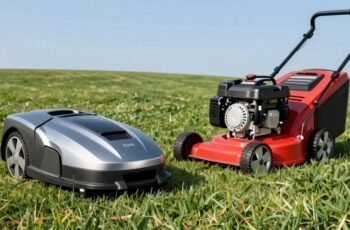
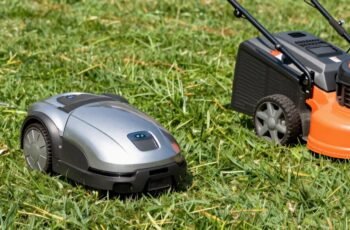
When it comes to maintaining a large or intricate lawn, choosing the right mower can considerably impact your effort and results. We recognize the dilemma of balancing power, convenience, and budget. Whether you’re considering a ride-on or a robot mower, each option has its strengths and limitations. To make an informed decision, it’s important to compare these two types carefully—so let’s explore what sets them apart and which might be best suited for your yard.
Key Takeaways
- Ride-on mowers suit large, uneven terrains and demanding lawns; robot mowers excel in small, flat, obstacle-free areas.
- Ride-on mowers have higher initial costs and require regular maintenance; robot mowers are more affordable and low-maintenance.
- Robot mowers are eco-friendly, quiet, and safer with obstacle detection; ride-on mowers emit pollutants and pose safety risks.
- Ride-on mowers offer high power and fast coverage but limited maneuverability; robot mowers are precise in tight spaces but slower on large lawns.
- Choice depends on lawn size, terrain complexity, budget, and desired convenience and safety features.
Which Lawn Mower Is Right for Your Yard?
Choosing the right lawn mower depends on your yard’s size, terrain, and how much effort you’re willing to invest. If you have a large, flat lawn, a ride-on mower can make the job faster and less tiring, offering comfort and power for extensive areas. For smaller yards, a robot mower might be ideal, especially if you prefer a low-maintenance option that mows automatically. Hilly or uneven terrain may influence your choice, as some mowers handle slopes better than others. Consider your physical ability and time commitment too. If you enjoy mowing and want control, a traditional ride-on might suit you. If you prefer convenience and minimal effort, a robot mower offers a hands-off approach. Assess your yard’s specific needs to find the best fit.
Comparing Ride-On and Robot Mowers: Key Differences
While both ride-on and robot mowers are designed to maintain lawns efficiently, they serve different needs and preferences. Ride-on mowers are powerful, ideal for large or uneven yards, offering control and quick coverage. Robot mowers, on the other hand, are compact, quiet, and perfect for smaller, flat lawns, providing automated, hands-free operation.
| Ride-On Mower | Robot Mower |
|---|---|
| Powerful, fast, and suitable for large yards | Quiet, autonomous, ideal for small lawns |
| Requires manual operation | Runs independently with minimal supervision |
| Higher initial cost, larger storage | Lower maintenance, easy to store |
Choosing between them depends on your lawn size, terrain, and how much effort you’re willing to invest.
Choosing the Best Mower for Your Lawn Size and Terrain
Selecting the right mower depends heavily on your lawn’s size and terrain, as these factors determine the most efficient and practical option. For large, open areas, a ride-on mower offers power and coverage, making mowing faster and easier. If your lawn is hilly or uneven, a mower with good traction and stability is essential, regardless of type. For smaller or flatter lawns, a robot mower can handle maintenance with minimal effort, especially if obstacles are few. Consider the terrain’s complexity—thick grass or rough patches may require a more robust ride-on. Conversely, smooth, well-maintained lawns are perfect for automated mowers. Ultimately, understanding your lawn’s size, slope, and obstacles helps you choose the mower that maximizes efficiency and minimizes hassle.
How Do Ride-On and Robot Mowers Compare in Cost and Maintenance?
When comparing ride-on and robot mowers, cost and maintenance are key factors that can influence your long-term satisfaction with your choice. Ride-on mowers generally have a higher upfront cost, often ranging from a few thousand dollars, but they’re built for durability and can handle larger lawns efficiently. Maintenance involves regular oil changes, blade sharpening, and occasional repairs, which can add to ongoing expenses. Robot mowers, on the other hand, tend to be more affordable initially, especially smaller models, and have lower maintenance costs. They require minimal upkeep—mostly software updates, blade replacements, and battery care. Over time, robot mowers can save you money on labor and fuel, but their longevity might be shorter than ride-ons, which are designed for heavy-duty use.
Are Ride-On or Robot Mowers Safer and More Eco-Friendly?
When comparing ride-on and robot mowers, we consider their emission levels, safety features, and energy efficiency. Robot mowers generally produce fewer emissions and operate more quietly, making them more eco-friendly. However, safety concerns vary, with ride-on mowers often equipped with more exhaustive safety features, but also posing greater risks if not used carefully.
Emission Levels Comparison
While ride-on mowers have long been the standard for large lawns, robot mowers are gaining popularity partly because they tend to be more eco-friendly. Ride-on mowers typically run on gasoline or diesel, emitting higher levels of pollutants like carbon monoxide, nitrogen oxides, and particulate matter. In contrast, robot mowers operate on rechargeable batteries, producing zero tailpipe emissions. This switch to electric power markedly reduces air pollution and greenhouse gas emissions. Additionally, robot mowers are more energy-efficient, often consuming less power than their gas-powered counterparts. By minimizing harmful emissions and utilizing cleaner energy sources, robot mowers offer a greener alternative. For those concerned with environmental impact, choosing a robot mower can make a noticeable difference in reducing your lawn’s carbon footprint.
Safety Features and Risks
Are robot mowers safer than ride-on models? Generally, yes. Robot mowers have built-in safety features like obstacle detection, boundary sensors, and automatic shut-offs if lifted or tilted. These features reduce the risk of injury during operation. Ride-on mowers, on the other hand, pose higher risks due to their size, power, and exposed blades, which can cause serious accidents if not handled carefully. However, ride-on models often include safety switches, seat sensors, and emergency shut-off systems. While both types aim to prevent accidents, robot mowers are designed with more advanced safety tech, making them safer for users and children around the yard. Nonetheless, proper usage and safety precautions are essential for both mower types to minimize risks.
Energy Efficiency Benefits
Ever wondered which mower type is more eco-friendly and energy-efficient? Generally, robot mowers excel in energy savings because they operate on rechargeable batteries, use less power, and mow gradually, reducing waste. Ride-on mowers consume more fuel or electricity, producing higher emissions. To compare:
| Feature | Ride-On Mower | Robot Mower | Benefits |
|---|---|---|---|
| Power Source | Gasoline/Electric | Rechargeable Battery | Lower emissions, quieter |
| Energy Consumption | Higher | Lower | Cost-effective, eco-friendly |
| Operating Efficiency | Fast but fuel-consuming | Slow but efficient | Less environmental impact |
In short, robot mowers are better for eco-friendliness and energy efficiency, helping reduce your carbon footprint.
Pros and Cons of Ride-On Mowers for Large Lawns
Ride-on mowers offer strong power and excellent cutting capacity for large lawns, making quick work of substantial areas. However, they can be challenging to maneuver around obstacles and tight spaces. Additionally, operating costs and maintenance needs can add up over time, impacting long-term affordability.
Power and Cutting Capacity
While ride-on mowers are often praised for their power, their true strength lies in their impressive cutting capacity, especially on large lawns. These machines deliver high horsepower, enabling them to handle thick grass and tough terrain with ease. They typically feature wide cutting decks, which mean fewer passes and faster coverage of expansive areas. This efficiency is ideal for maintaining large properties quickly. However, the power isn’t just about speed; it also guarantees a clean, even cut, improving lawn health and appearance. That said, this strength can come with increased fuel consumption and higher energy requirements. Overall, ride-on mowers excel when it comes to tackling large, demanding lawns, offering a combination of power and cutting capacity that’s hard to match.
Maneuverability Challenges
Despite their impressive power and wide cutting decks, ride-on mowers can face notable maneuverability challenges on large lawns. Navigating tight corners or obstacles like trees and flower beds can be tricky, especially with their size and turning radius. This often requires extra attention and careful driving to avoid damaging the lawn or equipment. Large lawns with complex layouts can also slow down mowing efficiency, as the mower needs to make multiple passes or complex turns. Additionally, uneven terrain or slopes might cause stability issues or difficulty steering. While ride-on mowers excel in covering large areas quickly, their bulk can limit agility, making precise maneuvering more challenging compared to smaller or more specialized equipment. Overall, maneuverability can be a significant consideration for large, intricate lawns.
Operating Costs and Maintenance
Are ride-on mowers a cost-effective choice for maintaining large lawns? They can be, but it depends on how much you value their durability and power. Ride-on mowers often have higher upfront costs and require regular maintenance like oil changes, blade sharpening, and engine checks, which can add up over time. However, they tend to be more reliable for extensive lawns, handling tough terrain and heavy use without breaking down frequently. Fuel consumption can be significant, increasing operating expenses. On the plus side, their larger cutting decks mean faster mowing, saving time and labor. Maintenance might be more intensive than with robotic mowers, but their robustness and ability to handle large, uneven terrains often justify the costs for large lawn owners.
Advantages and Disadvantages of Robot Mowers for Small and Complex Lawns
Have you ever wondered how well robot mowers perform on small, intricate lawns? They excel in maneuvering tight spaces and complex designs, thanks to their precise sensors and programming. This makes them ideal for detailed landscaping and areas with many obstacles. However, their small cutting decks mean they might take longer to cover larger or highly detailed lawns. On the downside, robot mowers can struggle with very uneven terrain or thick, overgrown grass. They also require a reliable power source and regular boundary adjustments to prevent wandering. While they’re quiet and energy-efficient, their limited cutting capacity and occasional difficulty with complex features can be disadvantages for small, intricate lawns. Overall, they’re great for maintenance but may need complementary tools for detailed work.
Which Mower Offers Better Long-Term Value and Performance?
When considering long-term value and performance, choosing between a ride-on mower and a robot mower depends on your lawn’s size, complexity, and maintenance needs. Ride-on mowers typically have higher upfront costs but are durable and effective for large, uneven terrains, offering powerful cutting performance that can handle tough grass and obstacles. They also require regular maintenance but tend to last many years with proper care, providing consistent performance over time. Robot mowers, on the other hand, excel in convenience and low maintenance, especially for smaller, simpler lawns. While their initial investment may be lower, replacement batteries and parts can add up. Overall, ride-on mowers often deliver better long-term value for larger, demanding lawns, whereas robot mowers suit smaller, low-maintenance needs with consistent performance.
How to Decide Between a Ride-On and a Robot Mower for Your Home
Choosing the right mower for your home depends on evaluating your specific lawn needs and lifestyle. First, consider your lawn size and terrain. If you have a large, uneven yard, a ride-on mower offers comfort and power, making mowing faster and easier. For smaller or flat lawns, a robot mower might be more practical, saving time and effort with minimal maintenance. Think about your schedule—if you prefer quick, occasional mowing, a ride-on is ideal. If you want automatic, ongoing lawn care, a robot mower is perfect. Also, factor in budget, storage space, and how much physical effort you’re willing to invest. Ultimately, your decision hinges on balancing lawn size, terrain, convenience, and personal preferences to find the best fit.
Frequently Asked Questions
Can Ride-On and Robot Mowers Handle Uneven or Hilly Terrain Effectively?
Yes, both ride-on and robot mowers can handle uneven or hilly terrain effectively, but ride-on mowers generally perform better on steep or complex slopes due to their power and stability, while robot mowers suit milder inclines.
What Are the Installation Requirements for Robot Mowers?
Robot mowers generally require a flat, obstacle-free area with a boundary wire setup. We recommend clearing debris, marking boundaries clearly, and ensuring a stable charging station location for smooth installation and peak performance.
How Do Mower Battery Life and Charging Times Compare?
Coincidentally, mower battery life varies; ride-on models often last longer per charge, while robot mowers typically require quick, frequent recharges. We find robot charging times are shorter, but ride-ons excel in extended mowing sessions.
Are There Any Legal or HOA Restrictions on Robot Mower Use?
We find that legal and HOA restrictions on robot mower use vary by location. We recommend checking local ordinances and HOA rules first, as some areas may have limitations on autonomous mowing or specific requirements for privacy and safety.
How Do Mower Noise Levels Impact Neighbor Relations?
We find that quieter robot mowers help maintain good neighbor relations by reducing noise disturbances, especially early mornings or late evenings. Lower noise levels show respect, preventing conflicts and fostering a more harmonious neighborhood environment.
Conclusion
So, which mower is truly the right one for you? The decision isn’t easy, and each option has its own strengths and surprises. Will the ride-on’s power or the robot’s convenience win your approval? As you weigh your yard’s needs and your lifestyle, remember—there’s more to take into account than just price. The perfect choice could be closer than you think, waiting to transform your lawn care routine in ways you never expected.