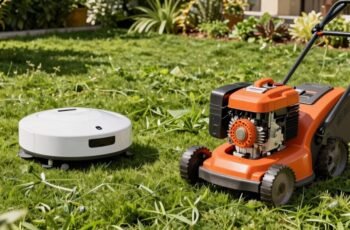
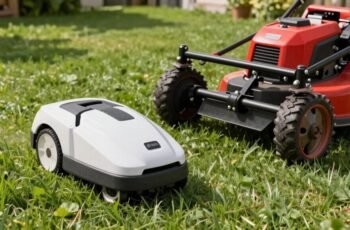
Many believe that choosing between a robotic mower and a riding mower is straightforward, but the decision often depends on more than just lawn size. While robotic models promise automation and quiet operation, riding mowers offer power and control for larger or more complex terrains. So, which option truly fits your needs? Exploring the differences in design, ease of use, and maintenance can reveal insights that might change your perspective entirely.
Key Takeaways
- Robotic mowers are fully automated, quiet, and ideal for small to medium lawns, while riding mowers require manual operation for larger areas.
- Robotic mowers are beginner-friendly with simple controls, whereas riding mowers demand more skill and experience to operate effectively.
- Initial costs for robotic mowers are higher, but they generally require less maintenance than riding mowers, which need regular, intensive upkeep.
- Robotic mowers excel at precise, consistent cuts for routine maintenance, but may struggle with complex terrains; riding mowers handle large, uneven lawns efficiently.
- Robotic mowers use sensors and boundary wires for obstacle detection, while riding mowers rely on manual steering and operator judgment.
What Factors Should I Consider When Choosing a Lawn Mower?
When choosing a lawn mower, it’s essential to take into account the size and terrain of your yard. Larger lawns often require more powerful mowers with wider cutting decks to save time. If your yard has uneven or hilly terrain, you’ll need a mower with good stability and possibly a self-propelled feature. Flat, small to medium-sized yards can comfortably use push mowers or compact options. Consider the type of grass and its growth rate—thicker grass may need a mower with higher horsepower. Also, think about storage space and ease of use. If you prefer less physical effort, a riding mower or robotic mower might be better. Ultimately, matching your yard’s specifics with the mower’s features guarantees efficient, effective mowing.
How Do Robotic and Riding Mowers Differ in Design and Operation?
Robotic and riding mowers differ considerably in both design and operation, reflecting their distinct approaches to lawn care. Robotic mowers are compact, low-profile devices that navigate your yard autonomously, using sensors and boundary wires to stay within designated areas. They cut grass gradually and evenly, often operating quietly and automatically on a scheduled basis. In contrast, riding mowers resemble small tractors with large cutting decks and seats for the operator. They require manual control, with a steering wheel or levers to guide movement. Riding mowers are built for larger lawns and faster cutting, offering more power and control to the operator. While robotic mowers focus on convenience and automation, riding mowers emphasize manual operation and efficiency for substantial yards.
Which Mower Is Easier for Beginners to Use?
Choosing the right mower can be intimidating for beginners, but generally, robotic mowers tend to be easier to operate without much prior experience. They’re designed for simplicity, often requiring just a few steps to get started. Imagine:
- Pressing a single button to turn it on.
- Setting a schedule with simple controls.
- Watching it autonomously navigate your yard.
- Forgetting about complex steering or adjustments.
In contrast, riding mowers demand more skill, like steering, adjusting speeds, and maneuvering around obstacles. Robotic mowers are more intuitive, making them ideal for newcomers. They handle routine tasks with minimal input, so you can focus on enjoying your yard without stressing over complex controls. Overall, robotic mowers are generally more beginner-friendly.
What Are the Cost Differences Between Robotic and Riding Mowers?
The initial cost of robotic mowers is generally higher than riding mowers, but they often save money over time with lower maintenance. Riding mowers tend to have lower upfront prices but can incur higher long-term expenses for repairs and fuel. Understanding these differences helps us decide which option fits our budget and long-term needs.
Initial Purchase Expenses
While robotic mowers often come with a higher upfront cost, their initial purchase price is generally lower than that of riding mowers. When you compare costs, envision this:
- A robotic mower might cost around $1,000 to $3,000, depending on features.
- A basic riding mower starts at roughly $1,500 and can go well beyond $4,000 for advanced models.
- The robotic mower’s price often includes smart technology and sensors, reducing additional expenses.
- Riding mowers may require extra attachments like trailers or snow blades, increasing overall costs.
Long-Term Maintenance Costs
Though robotic mowers typically have lower ongoing maintenance costs, riding mowers often require more frequent repairs and part replacements over time. Robotic models generally need minimal upkeep—just occasional blade changes and software updates—making them more cost-effective long-term. Riding mowers, on the other hand, have more complex engines, transmissions, and belts that wear out faster, leading to higher repair bills. Additionally, riding mowers often consume more fuel, adding to regular expenses. Maintenance schedules for riding mowers can be intensive, requiring regular oil changes, air filter replacements, and tune-ups. While robotic mowers may have some replacement parts over the years, their overall maintenance costs tend to stay lower, especially when considering the costs associated with repairs, fuel, and labor for riding mowers.
Which Mower Is More Efficient for Lawn Maintenance?
When comparing robotic mowers and riding mowers for lawn maintenance, efficiency depends largely on the size and complexity of the yard. Robotic mowers excel in small to medium yards with straightforward layouts, working quietly and automatically to maintain consistent grass height. Riding mowers, however, are better suited for larger, more intricate lawns that require quick coverage and power. To visualize, consider:
Robotic mowers suit small to medium yards, while riding mowers excel for large, complex landscapes.
- Robotic mower silently trimming along flower beds and around trees without supervision.
- Riding mower swiftly covering expansive fields, reducing mowing time considerably.
- Robotic units maneuvering tight corners and obstacles with ease.
- Riding mowers tackling uneven terrain and dense grass with higher horsepower.
Ultimately, the choice hinges on yard size, landscape complexity, and desired maintenance speed.
How Do Robotic and Riding Mowers Handle Lawn Care and Precision?
Both robotic and riding mowers excel in different areas of lawn care precision. We’ll look at how accurately they cut, how well they navigate obstacles, and the control options they offer. Understanding these points helps us see which mower suits your lawn’s specific needs.
Cutting Precision and Accuracy
Robotic mowers excel in delivering consistent, precise cuts thanks to their advanced sensors and programming, which allow them to navigate complex lawn layouts with minimal human input. They cut evenly, maintaining uniform height across the entire yard. Their accuracy ensures no patches are missed or overcut, resulting in a tidy appearance. To visualize this, consider:
- The robotic mower consistently trims grass to the same height, regardless of terrain variations.
- It follows a methodical pattern, avoiding missed spots or uneven patches.
- The blades cut cleanly, leaving sharp edges and a professional look.
- The mower adjusts to small irregularities, maintaining precision even near borders and flower beds.
This level of accuracy makes robotic mowers ideal for homeowners who prioritize a neat, professional finish.
Navigation and Obstacle Avoidance
Managing complex lawn layouts and avoiding obstacles is a critical aspect of lawn mower performance, and robotic and riding mowers handle this challenge quite differently. Robotic mowers use sensors, cameras, and GPS technology to detect obstacles and navigate around them efficiently. They create a map of your yard, adjusting their route to avoid trees, flower beds, and other objects. In contrast, riding mowers typically rely on manual operation, with limited obstacle detection features. Some models have bump sensors, but they require the operator to steer around obstacles actively. Robotic mowers excel in autonomous navigation, ensuring consistent coverage without the need for human intervention. Riding mowers, while more flexible in handling uneven terrain, depend heavily on the driver’s skill to avoid hazards.
Customization and Control Options
When it comes to lawn care, the level of customization and control offered by robotic and riding mowers varies considerably, affecting how precisely we can tailor our mowing routines. Robotic mowers often feature app-based controls, allowing us to set mowing schedules, adjust cutting heights, and define specific zones remotely. They can also offer terrain sensitivity, adapting to slopes and obstacles, and enable boundary marking for precision. Riding mowers, on the other hand, typically have manual controls—levers, dials, and dashboards—that let us adjust speed, engage attachments, and select pre-set mowing modes. Here’s a quick look:
- App controls for robotic mowers
- Manual levers and dials for riding mowers
- Zone and boundary setting options
- Adjustable cutting heights and speeds
Both systems provide tailored options, but robotic mowers excel in remote, detailed customization.
Are Robotic Mowers Suitable for Large or Complex Lawns?
While robotic mowers have become increasingly popular, their suitability for large or complex lawns depends on several factors. For extensive areas, these mowers can work efficiently, especially with boundary wires and mapping features. However, terrain complexity matters—steep slopes or uneven ground can challenge their capabilities. Complex lawns with many obstacles, flower beds, or narrow passages may hinder movement, requiring careful planning or additional boundary setup. Battery life is another consideration; larger lawns demand longer mowing times or multiple units. While some high-end models handle larger, intricate lawns well, others may struggle or require frequent recharging and manual intervention. Overall, robotic mowers can serve large or complex lawns effectively, but their success hinges on the lawn’s specific features and the mower’s advanced features.
What Maintenance and Repair Tasks Do Each Mower Require?
Robotic and riding mowers both require regular maintenance to keep them operating efficiently, but the tasks involved differ considerably. For robotic mowers, we mainly focus on:
- Clearing debris and trimming grass clippings from sensors and blades
- Replacing or sharpening blades every few months
- Checking and cleaning the charging station and sensors
- Updating software and firmware for peak performance
In contrast, riding mowers need:
- Regular oil changes and filter replacements
- Inspecting and sharpening blades weekly
- Checking tire pressure and adjusting as needed
- Lubricating moving parts like wheel bearings and steering mechanisms
Both types demand attention, but the robotic mower’s tasks are generally simpler and more frequent, while riding mowers require more intensive maintenance periodically.
Frequently Asked Questions
How Long Does It Take for a Robotic Mower to Mow a Typical Lawn?
It usually takes our robotic mower about 1 to 4 hours to mow a typical lawn, depending on the size, complexity, and grass height. We find it efficient, as it works quietly and automatically, saving us time and effort.
Can Robotic Mowers Handle Uneven or Sloped Terrains Effectively?
A stitch in time saves nine, and robotic mowers can handle uneven or sloped terrains reasonably well with advanced navigation features. We find they adapt effectively, but steep slopes may require additional adjustments for peak performance.
What Safety Features Are Included in Robotic and Riding Mowers?
Both robotic and riding mowers include essential safety features like emergency stops, obstacle detection, and blade shut-offs. We guarantee these systems help prevent accidents, making lawn care safer and more convenient for everyone.
Are There Environmental Benefits to Choosing a Robotic Mower Over a Riding Mower?
We believe robotic mowers are more environmentally friendly because they use less energy, produce fewer emissions, and operate quietly, reducing air pollution and noise pollution, making them a greener choice for maintaining your lawn.
How Do Weather Conditions Impact the Performance of Each Mower Type?
Weather conditions considerably impact both mowers; rain can clog robotic mowers and make lawns muddy, reducing efficiency, while riding mowers handle wet, uneven terrain better but risk damage or getting stuck. We consider these factors carefully.
Conclusion
Ultimately, choosing between a robotic and riding mower depends on your lawn’s size, terrain, and your priorities. Robotic mowers excel in convenience and precision, perfect for smaller, well-maintained lawns, while riding mowers offer power and control for larger or uneven terrains. As the saying goes, “A stitch in time saves nine”—investing in the right mower now can make lawn care effortless and enjoyable in the long run.