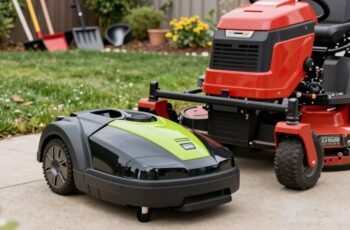
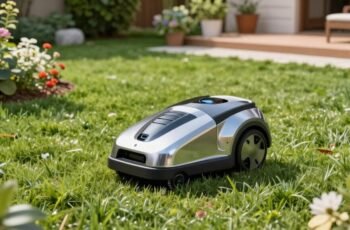
Like a trusted compass guiding us through unfamiliar territory, understanding how robot lawn mowers save us time can transform the way we maintain our yards. But not all models are created equal, and factors like yard size and terrain play a vital role in their efficiency. Curious to see which features truly make a difference and how to choose the best option for your landscape? There’s more to evaluate than meets the eye, and uncovering these details can lead to real time savings.
Key Takeaways
- Advanced navigation systems like GPS reduce overlap, ensuring faster, more complete mowing sessions.
- Automated scheduling allows mowing during off-peak hours, saving manual effort and time.
- Larger battery capacities enable longer runtimes, minimizing recharging interruptions on big lawns.
- Terrain-adaptive sensors prevent delays caused by obstacles, improving overall efficiency.
- Matching mower features to yard size and complexity maximizes coverage and reduces mowing time.
How Do Robot Lawn Mowers Save You Time?
Have you ever wondered how robot lawn mowers manage to save so much of your time? These devices are designed to operate independently, so you don’t have to spend hours pushing a traditional mower around your yard. They work on a schedule you set, automatically trimming your grass in small, manageable sections. Their sensors and boundary wires keep them within designated areas, ensuring full coverage without supervision. Thanks to their smart navigation, they avoid obstacles, reducing the need for manual intervention. Plus, they mow regularly, preventing overgrowth and the need for intensive cleanup. All these features combine to free up your time, letting you focus on other activities while your yard stays perfectly maintained without any effort on your part.
Key Features That Make Robot Mowers More Efficient
Smart navigation systems help robot mowers cover your lawn efficiently without missing spots. Automated scheduling features allow the mower to operate automatically at convenient times, saving you effort. Together, these key features maximize time savings and keep your yard looking perfect.
Intelligent Navigation Systems
Intelligent navigation systems are what enable robot lawn mowers to operate more efficiently and accurately. These systems use advanced sensors, GPS, and mapping technology to understand the layout of your yard. This allows the mower to plan the most effective route, avoiding obstacles and covering every inch without unnecessary passes. Unlike random or manual patterns, intelligent navigation guarantees thorough and consistent mowing, saving time and energy. It also reduces wear on the mower and prevents missed spots or repeated areas. With real-time adjustments, the mower can adapt to changing conditions, such as new obstacles or weather changes. Overall, these systems make robotic mowers smarter, faster, and more reliable, delivering a perfectly manicured lawn with less effort and time.
Automated Scheduling Features
How do robot mowers maximize efficiency? Automated scheduling features play a key role by allowing us to set precise mowing times without manual intervention. These systems analyze your lawn’s size and shape to create an ideal mowing plan, reducing unnecessary trips and overlaps. The mower adapts to your preferred schedule, ensuring consistent maintenance even when you’re away. Plus, it can adjust mowing times based on weather conditions or growth patterns, preventing over-mowing or missed patches.
Some features include:
- Customizable daily or weekly schedules
- Automatic adjustments for weather changes
- Zone-specific mowing plans
- Seamless integration with smart home systems
These features work together to keep your lawn perfectly maintained while saving you time and effort.
Which Robot Mowers Are Best at Saving Time for Your Yard Size?
Choosing the right robot mower depends largely on your yard size, as different models are designed to maximize efficiency for specific areas. For small lawns under a quarter-acre, compact models with simple navigation work well and save time by quickly covering the space. Medium-sized yards, around a quarter to half an acre, benefit from mowers with smarter navigation and larger cutting decks, reducing the number of runs needed. For larger properties exceeding half an acre, consider models with advanced GPS mapping and larger battery capacities, which can handle extensive areas without frequent recharges. Some mowers even feature boundary wires or boundary-free systems for seamless coverage. Selecting a mower suited to your yard size guarantees efficient mowing, reducing your overall time spent maintaining your lawn.
How Yard Size and Terrain Affect Robot Mower Performance
Yard size and terrain play a crucial role in determining how well a robot mower performs, as these factors directly impact coverage and efficiency. Larger yards require more powerful models with longer battery life, while uneven terrain can challenge the mower’s ability to navigate smoothly. Steep slopes may slow down mowing or cause difficulty in certain areas, affecting overall time savings. Flat, open spaces allow for faster, more uniform mowing, maximizing efficiency. Complex landscapes with many obstacles demand models with advanced sensors and navigation features. To get the best results, consider the specific features of your yard when choosing a mower, ensuring it matches your terrain and size for ideal time savings and performance.
- Large yards need longer-lasting batteries and bigger cutting areas
- Hilly or uneven terrain may require specialized models
- Obstacles like trees and flower beds can slow down mowing
- Flat, open lawns promote faster, more efficient coverage
Tips for Programming and Maintaining Your Robot Lawn Mower
Once you’ve selected a mower suited to your yard’s size and terrain, proper programming and maintenance become key to guaranteeing it performs at its best. Start by setting a consistent mowing schedule that matches your grass growth rate; this prevents overworking the mower and keeps your lawn healthy. Regularly clear debris, such as grass clippings and leaves, from the blades and sensors, so the mower runs smoothly. Check and tighten components like wheels and blades periodically to avoid breakdowns. Use the app or control panel to program boundary zones accurately, avoiding obstacles and sensitive areas. Finally, change the blades as needed to ensure clean cuts. Proper upkeep and thoughtful programming maximize efficiency, reduce downtime, and extend your mower’s lifespan.
Real-Life Examples: How Much Time Can You Save?
Real-life experiences clearly demonstrate the time-saving benefits of robot lawn mowers. For example, a homeowner with a medium-sized yard reports cutting mowing time from over an hour to just 15 minutes daily. Another person with a large lawn saves hours each weekend by letting the robot handle regular trims. Some users find they spend half as much time maintaining their yard, freeing up weekends. Additionally, busy professionals appreciate the convenience of automatic mowing, with minimal effort needed from them. These examples show how robot mowers can drastically reduce lawn care time, giving homeowners more freedom to enjoy their outdoor spaces or relax. The consistent, scheduled mowing guarantees a tidy yard without the manual effort, transforming lawn care into a quick, effortless task.
What Could Limit Your Robot Mower’s Time Savings?
While robot lawn mowers are designed to save time, several factors can limit their efficiency and overall savings. For instance, uneven terrain or thick, tall grass can slow down mowing and cause the robot to work longer hours. Obstacles like trees, garden furniture, or uneven slopes may require manual intervention or cause the mower to take detours, reducing its efficiency. Battery life is another factor; if the mower’s battery isn’t strong enough for large lawns, it’ll need frequent recharging, interrupting the mowing schedule. Additionally, adverse weather conditions like rain or high winds can hinder operation or damage the mower, delaying its work. Ultimately, these limitations can reduce the time savings you expect from a robot mower, making proper planning and maintenance essential.
How to Choose the Right Robot Lawn Mower for Maximum Time Savings
When selecting a robot lawn mower, we need to take into account the size of our lawn to ensure it can handle the area efficiently. We should also look at cutting system features that give us the best performance and navigation technology options that keep the mower moving smoothly. Making these choices helps maximize our time savings and keeps our lawn looking great.
Lawn Size Compatibility
How do you determine the right robot lawn mower for your yard’s size? First, measure your lawn to understand its total area. This helps you choose a mower with enough battery life and coverage capacity. Smaller yards may only need compact models that mow quickly, while larger lawns require more powerful mowers with extended runtimes. Consider these factors:
- Yard size: A small yard (up to 1/4 acre) needs a basic model, while larger areas (over 1 acre) require heavy-duty options.
- Battery life: Longer runtimes are essential for big lawns to avoid frequent recharging.
- Mowing schedule: Larger yards may need multiple daily sessions to keep grass tidy.
- Navigation ability: For complex landscapes, choose models with advanced navigation features to ensure complete coverage.
Matching your yard’s size with the mower’s capabilities ensures efficient, time-saving mowing.
Cutting System Features
Choosing the right cutting system is essential for maximizing your robot lawn mower’s efficiency and saving time. The cutting system determines how evenly and quickly your lawn gets trimmed. Some mowers feature rotary blades, which cut grass in a spinning motion, ideal for uneven terrain. Others have mulching blades, which chop grass into fine pieces, fertilizing your lawn as they go. Still, some models offer edge-cutting capabilities for cleaner borders. Here’s a quick comparison:
| Cutting System | Best For | Key Feature |
|---|---|---|
| Rotary Blades | General lawns | Fast, versatile |
| Mulching Blades | Fertilizer lovers | Fine mulch |
| Edge-Cut Systems | Precise borders | Extended reach |
Choosing the right system tailored to your yard’s needs boosts time savings.
Navigation Technology Options
Selecting the right navigation technology can considerably boost your robot lawn mower’s efficiency and save you time. Different systems determine how well your mower covers the yard and avoids obstacles. Some use random patterns, which are simple but may take longer, while others employ more advanced techniques for faster, more thorough coverage.
Consider these options:
- Random navigation: Mows in unpredictable paths, suitable for smaller yards.
- Pattern-based navigation: Uses predefined routes for systematic coverage.
- GPS-guided navigation: Maps your yard precisely, ensuring efficient mowing and minimal overlap.
- Sensor-based navigation: Detects obstacles and adjusts routes automatically.
Choosing the right technology depends on your yard’s size, complexity, and your desire for time savings.
Frequently Asked Questions
Can Robot Lawn Mowers Handle Uneven or Sloped Terrains Effectively?
We find that many robot lawn mowers can handle uneven or sloped terrains effectively, especially models with adjustable height settings and robust wheels. We recommend checking specific product features to guarantee they suit your yard’s terrain.
How Do Weather Conditions Impact the Efficiency of Robot Lawn Mowers?
Weather can surprise us, and it definitely impacts our robot lawn mowers’ efficiency. Rain, extreme heat, or cold can slow down or temporarily halt mowing, reminding us that even technology isn’t immune to nature’s unpredictable moods.
Are There Safety Concerns Associated With Robot Lawn Mower Operation?
Yes, we should be cautious because robot lawn mowers can pose safety risks like cutting injuries or accidents if not properly used. We recommend following safety guidelines, keeping children and pets away, and maintaining the mower regularly.
What Is the Typical Lifespan of a Robot Lawn Mower With Regular Use?
A robot lawn mower typically lasts like a well-worn shoe, around 5-8 years with regular use. We find proper maintenance, like cleaning and blade replacement, extends its lifespan and keeps it running smoothly for years.
How Does Battery Replacement Frequency Affect Overall Time Savings?
Battery replacements can slightly reduce overall time savings, but since they’re infrequent, our robot mower still saves us significant time over manual mowing. Regular maintenance guarantees minimal disruption, keeping our lawn care efficient and hassle-free.
Conclusion
In fact, studies show robot lawn mowers can cut your mowing time by up to 70%. By choosing the right model and optimizing its settings, we can enjoy a perfectly manicured lawn without the hassle. With advanced navigation and tailored features, these mowers revolutionize yard care, giving us more free time. So, why not make the switch and reclaim hours each week? Your lawn—and your schedule—will thank you.