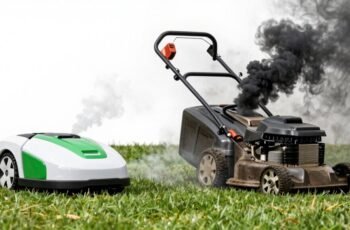
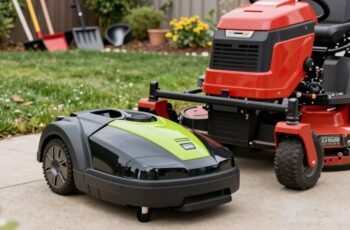
Imagine coming home after a busy day and finding your lawn neatly trimmed without lifting a finger—that’s the promise of modern mowing options. We often wonder whether a robot mower’s automation truly beats the control and speed of a ride-on. Each has its perks, but understanding which offers the most convenience for your yard might change how you approach lawn care. Let’s explore how these machines compare and what makes one more suitable for your lifestyle.
Key Takeaways
- Robot mowers offer autonomous operation, reducing manual effort and scheduling maintenance automatically for convenience.
- Ride-on mowers provide quick, straightforward control but require active driving, suitable for larger or uneven yards.
- Robot mowers navigate obstacles and adapt to yard changes, enhancing ease of maintenance and consistent lawn care.
- Ride-on mowers are easier to set up and operate initially, making them more practical for users preferring manual control.
- Overall convenience depends on yard size, terrain, desired automation level, and personal scheduling preferences.
How Do Robot Mowers and Ride-On Mowers Differ in Convenience?
While both robot mowers and ride-on mowers aim to make lawn care easier, they differ considerably in how convenient they actually are. Robot mowers operate autonomously, so you don’t need to push or steer them. You simply set a schedule, and they handle the mowing on their own, saving you time and effort. They’re perfect for maintaining regular trimming without manual labor. Ride-on mowers, on the other hand, require you to drive them around the yard. While they cover large areas quickly, they demand your active involvement and can be less flexible for frequent, small trims. Overall, robot mowers excel in convenience through automation, whereas ride-on mowers depend on your physical effort and direct control, impacting how easy each is to incorporate into your routine.
What Are the Best Setup and Maintenance Tips for Easy Lawn Care?
Getting your lawn set up for easy maintenance starts with choosing the right equipment and establishing a simple routine. First, select a mower suited to your lawn’s size and terrain—robot mowers work best on flat, smaller yards, while ride-on mowers handle larger spaces efficiently. Regularly check and sharpen blades to guarantee a clean cut, which promotes healthier grass. Keep the mower’s deck clear of debris and change oil or perform other routine fluids as recommended by the manufacturer. For robot mowers, confirm the charging station is accessible and the boundary wires are properly installed. Establish a maintenance schedule, like mowing weekly or biweekly, and stick to it. Consistent care prevents issues and keeps your lawn looking its best with minimal effort.
How Do Robot Mowers Save You Time and Effort?
Robot mowers save us time and effort by automating the entire mowing process, so we don’t have to spend hours pushing a traditional lawnmower. Once programmed, they work independently, mowing the lawn regularly without supervision. This means we can focus on other tasks or relax instead of manually tending to the grass. They navigate around obstacles and adapt to different yard sizes, maintaining a well-kept lawn with minimal input. Many models come with scheduling features, allowing us to set mowing times that suit our routines. Additionally, because they mow frequently and evenly, there’s less need for trimming or dealing with overgrown grass. Overall, robot mowers *considerably* reduce the physical effort and time commitment involved in lawn care.
Are Ride-On Mowers Easy to Operate and Maintain?
Ride-on mowers are designed to make lawn care straightforward, but many wonder just how easy they are to operate and maintain. In reality, they’re quite user-friendly, with simple controls and intuitive handling. Most models come with straightforward steering, throttle, and blade engagement, making it easy for beginners to learn. Maintenance, on the other hand, involves regular tasks like checking oil, sharpening blades, and cleaning air filters, which are manageable with basic tools and some routine effort. While they do require periodic upkeep, these tasks are generally simple and quick. Overall, ride-on mowers are built for ease of use, allowing us to focus on the lawn rather than struggling with complicated machinery.
How Do Automation and Control Features Make Mowing Simpler?
Automation and control features like smart navigation systems and automated scheduling make mowing much easier for us. These tools allow the mower to operate efficiently without constant supervision, saving time and effort. With these features, we can enjoy a well-maintained lawn with less hassle.
Smart Navigation Systems
Have you ever wondered how advanced navigation systems make mowing easier? These systems allow robotic mowers to efficiently cover your lawn without manual guidance. They use sensors and GPS to map out the area, avoiding obstacles and ensuring even coverage. This means less time spent on steering or fixing missed spots. Here’s a quick look at some features:
| Feature | Benefit | Example |
|---|---|---|
| GPS Navigation | Precise lawn coverage | Maps large yards efficiently |
| Obstacle Detection | Prevents collisions | Avoids trees and furniture |
| Boundary Sensors | Keeps mower within set limits | No manual fence installation |
| Path Planning | Optimizes mowing routes | Saves battery and time |
| Real-time Mapping | Adapts to yard changes | Handles seasonal growth |
Smart navigation makes mowing smarter and less hands-on.
Automated Scheduling Features
Smart navigation systems already help our robotic mowers cover lawns efficiently, but adding automated scheduling features takes convenience to the next level. With these features, we can set our mowers to operate automatically at specific times, even when we’re not around. This means we don’t have to remember to start or stop mowing; the mower takes care of it for us. We can customize schedules based on weather, growth rates, or our personal routines, ensuring the lawn stays tidy without manual effort. Automation also reduces the risk of over-mowing or missing spots. Overall, automated scheduling simplifies lawn maintenance, saving us time and energy while keeping our grass evenly cut and looking great.
Which Mower Works Best for Your Yard Size and Terrain?
Choosing the right mower depends on your yard size and terrain. Smaller, flat lawns often suit robot mowers, while larger or uneven spaces may need a ride-on. We’ll explore which options work best for different yard conditions to help you decide.
Suitable Yard Sizes
When selecting the right mower for your yard, understanding the size is essential. For smaller lawns, a robot mower is often ideal because it handles compact spaces efficiently and requires minimal effort. They’re perfect for yards up to a quarter-acre or less, where their automated features can keep the grass tidy daily. Ride-on mowers excel with larger areas—half an acre or more—because they cover ground quickly and handle extensive mowing tasks comfortably. If your yard is irregularly shaped or features tight corners, a ride-on mower provides better maneuverability. Conversely, robot mowers may struggle with complex layouts. Ultimately, matching your yard size to your mower choice guarantees efficient, convenient mowing without unnecessary hassle.
Terrain Compatibility
Have you considered how your yard’s terrain affects which mower is best? If your yard is flat and smooth, a robot mower can easily navigate and handle regular mowing without much effort. However, if your terrain is hilly or uneven, a ride-on mower might be more suitable because it offers better stability and power on challenging slopes. Steep inclines can be risky for robot mowers, which might struggle or even get stuck. Additionally, thick or dense grass can be harder for robots to cut efficiently, while ride-on mowers with larger engines can handle tougher conditions more effectively. Ultimately, understanding your yard’s terrain helps you choose the mower that will perform reliably and save you time, effort, and maintenance headaches.
Is the Cost of a Robot or Ride-On Mower Worth the Convenience?
Determining whether the cost of a robot or ride-on mower is justified by the convenience it offers depends on your specific needs and budget. For some, investing in a mower is a game-changer, saving hours of manual labor. Others may find the expense hard to justify, especially if their yard is small or infrequently maintained. To help, here’s a quick comparison:
| Factor | Value |
|---|---|
| Time Saved | Instant peace of mind |
| Effort | Less physical work |
| Cost | Significant upfront investment |
| Maintenance | Ongoing expenses |
| Satisfaction | Long-term convenience |
Ultimately, it’s about weighing the financial investment against the everyday ease it brings. If convenience outweighs the cost, it’s worth considering.
What Common Convenience-Related Issues Might You Encounter?
While robot and ride-on mowers offer significant convenience, they can also present some common issues that might disrupt their smooth operation. For robot mowers, obstacles like thick grass or uneven terrain can cause them to get stuck or miss patches. They may also struggle with complex yard layouts or narrow passages. Ride-on mowers, on the other hand, can have trouble starting or maintaining consistent power, especially if not maintained properly. Both types can face issues with battery life or fuel supply, limiting mowing time. Additionally, weather conditions like rain or high winds can interfere with mowing schedules.
- Obstacle detection failures
- Battery or fuel running out unexpectedly
- Difficult terrain or tight spaces
- Weather-related disruptions
How to Choose the Most Convenient Mower for Your Lifestyle
Choosing the right mower depends on how you use your yard and what kind of convenience matters most to you. First, consider your yard’s size and terrain. If you have a small, flat yard, a robot mower offers effortless, hands-free maintenance. For larger or uneven lawns, a ride-on mower provides quicker coverage and easier navigation. Think about your schedule—if you want minimal effort, automation suits you best. Also, decide whether you value speed or precision. Robot mowers are quiet and low-maintenance, ideal for those seeking quiet operation. Ride-on mowers are more powerful but require more storage and upkeep. By evaluating your yard’s needs, your daily routine, and your preferences for control, you can select a mower that truly fits your lifestyle and maximizes convenience.
Frequently Asked Questions
Can Robot Mowers Handle Complex Yard Layouts Efficiently?
Robot mowers can handle complex yard layouts efficiently with smart navigation systems, obstacle detection, and customizable boundary settings. We find they adapt well to intricate designs, making yard maintenance easier without manual effort.
How Do Ride-On Mowers Perform in Tight or Uneven Spaces?
Ride-on mowers struggle in tight, uneven spaces, often requiring manual maneuvering. We find them less efficient there, whereas robot mowers excel in handling complex layouts with precision, making yard maintenance easier and more consistent for us.
Are There Safety Concerns With Automated Mower Features?
Safety concerns with automated mower features are like hidden rocks in a river—unexpected and potentially dangerous. We stay cautious, always attentive, and guarantee fences and sensors are in place, preventing surprises and keeping everyone, including pets, safe.
What Are the Environmental Impacts of Each Mower Type?
We believe robot mowers are more eco-friendly, emitting less noise and pollution, while ride-on mowers consume more fuel and produce higher emissions. Both impact the environment, but robot mowers offer a greener, quieter alternative.
How Do Weather Conditions Affect Mower Convenience and Operation?
Weather conditions greatly influence mower convenience and operation; rain can cause delays or damage, while extreme heat or cold may hinder performance or require extra maintenance, making us adapt our mowing routines to keep everything running smoothly.
Conclusion
Overall, choosing between a robot mower and a ride-on depends on your yard size, terrain, and lifestyle. Did you know that 60% of robot mower owners report saving at least 2 hours weekly? With the right choice, you’ll enjoy effortless lawn care, more free time, and a beautiful yard. We hope this guide helps you find the most convenient mower to fit your needs and make lawn maintenance a breeze.