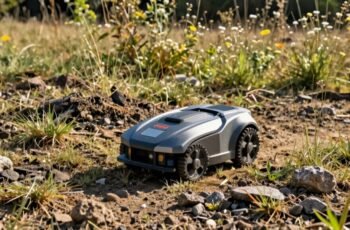
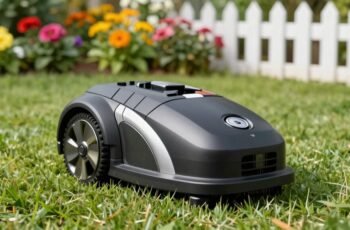
When evaluating robotic mower performance, suspension features are critical for steering uneven terrain effectively. These systems improve stability, protect delicate surfaces, and guarantee consistent blade contact, especially on slopes or obstructed areas. Understanding how various suspension components work together can influence your choice of mower, as advanced and adjustable suspensions offer notable benefits. Exploring these technical aspects reveals how suspension technology directly impacts efficiency and longevity—details that are essential for making informed decisions about robotic lawn care.
Key Takeaways
- Suspension systems absorb shocks and vibrations for improved stability and a cleaner cut on uneven terrain.
- Key components include shock absorbers, suspension arms, ball joints, and stabilizers for flexible terrain adaptation.
- Adjustable suspensions maintain consistent blade height, enhance traction, and protect delicate surfaces during operation.
- Proper suspension reduces wear on wheels and components, extending mower durability and simplifying maintenance.
- Advanced systems utilize sensor-driven, active suspension for dynamic terrain adjustment and optimized mowing performance.
How Suspension Systems Improve Navigation Over Uneven Terrain
Suspension systems play a crucial role in enhancing a robot mower’s ability to navigate uneven terrain effectively. They absorb shocks and vibrations caused by irregular ground surfaces, maintaining consistent contact between the mower’s blades and the grass. This stability guarantees precise cutting and reduces the risk of slipping or tipping over on slopes or rough patches. Suspension components dynamically adjust to terrain variations, distributing weight evenly and preventing excessive pressure on any single wheel or section. This adaptability allows the mower to traverse dips, bumps, and inclines with minimal loss of traction or control. Ultimately, a well-designed suspension system enhances maneuverability, preserves mechanical integrity, and guarantees consistent mowing performance across diverse terrains.
Key Components of Robot Mower Suspension Systems
Understanding the key components of robot mower suspension systems is essential for optimizing performance on uneven terrain. We will examine shock absorbers and their role, review different suspension types, and identify the primary components that guarantee stability. This overview provides the foundation for designing effective suspension solutions for robotic mowing.
Shock Absorbers Functionality
How do shock absorbers enhance the performance of robot mower suspension systems? They serve to dampen vibrations and absorb impacts from uneven terrain, maintaining consistent contact between the mower’s blades and the ground. Shock absorbers utilize hydraulic or pneumatic mechanisms to convert kinetic energy from terrain irregularities into thermal energy, reducing oscillations transmitted to the chassis. This stabilization minimizes mechanical stress on components, prolongs device lifespan, and guarantees a smooth, precise mowing operation. Properly functioning shock absorbers improve traction by maintaining ideal wheel-ground contact, even on rough surfaces. Additionally, they prevent excessive bouncing, which can cause uneven cuts or damage to the mower deck. Fundamentally, shock absorbers are critical for ensuring stability, efficiency, and longevity of robot mower suspension systems.
Suspension Types Overview
Different types of suspension systems incorporate various key components to enhance a robot mower’s stability and maneuverability. These systems primarily include independent, dependent, and torsion-based configurations. Independent suspensions allow each wheel to move independently, enhancing adaptability over uneven terrain. Dependent suspensions connect wheels via a common linkage, providing a more rigid response for consistent ground contact. Torsion suspensions utilize flexible elements, such as torsion bars, to absorb shocks while maintaining consistent wheel alignment. Each suspension type influences the mower’s ability to navigate complex surfaces, affecting stability, traction, and cutting precision. Selecting an appropriate suspension involves understanding the terrain characteristics and operational demands, ensuring the system maintains ideal wheel contact and minimizes vibrations for efficient mowing performance.
Key Suspension Components
The effectiveness of a robot mower’s suspension system hinges on its key components, which work together to absorb shocks, maintain wheel contact, and guarantee stability across varied terrains. Central to this are the shock absorbers, typically hydraulic or spring-based, which dampen impact forces. The suspension arms connect the chassis to the wheels, allowing vertical movement to adapt to uneven surfaces. Ball joints and pivot points enable smooth articulation, preventing excessive tilting or wheel lift. The stabilizers or anti-scalp wheels provide additional support, ensuring consistent contact and preventing damage from obstacles. Together, these components form a precise, interconnected system that optimizes terrain adaptation, minimizes vibrations, and enhances the mower’s overall operational stability.
How Shock Absorbers and Springs Enhance Cutting Stability
Shock absorbers and springs play a critical role in maintaining cutting stability by effectively dampening vibrations and uneven terrain impacts. They absorb and dissipate energy from surface irregularities, preventing excessive oscillations that could compromise cutting precision. Springs provide restoring force, maintaining consistent contact between the mower deck and ground, which guarantees uniform blade engagement. Shock absorbers, often hydraulic or pneumatic, control the rate of movement, reducing sudden jolts and minimizing mechanical stress. This combination maintains ideal blade height and minimizes lateral sway, resulting in cleaner cuts and improved overall lawn appearance. Precise tuning of these components allows the mower to adapt dynamically to terrain variations, guaranteeing stability without sacrificing maneuverability or efficiency.
The Role of Suspension in Obstacle Detection and Avoidance
The suspension system plays a critical role in enhancing terrain adaptability, allowing the mower to maintain consistent contact with uneven surfaces. This stability improves obstacle negotiation by enabling the mower to detect and respond to obstacles more accurately. Consequently, suspension directly contributes to more reliable obstacle detection and safer navigation.
Enhanced Terrain Adaptability
Suspension systems substantially enhance a robot mower’s ability to navigate diverse terrains by maintaining consistent ground contact and stability. This stability allows sensors to perform accurately, even on uneven surfaces. By absorbing shocks from irregularities such as slopes, rocks, and uneven ground, suspension preserves wheel traction and minimizes slippage. Improved terrain adaptability ensures the mower can operate efficiently across lawns with varied features, reducing the risk of tipping or losing control. The suspension’s ability to adjust to terrain variations enables continuous operation without interruption for manual adjustments or repositioning. This precise adaptation supports the mower’s overall performance, ensuring consistent cutting performance and safety on challenging terrains, while also reducing mechanical stress on components.
Improved Obstacle Negotiation
Enhanced terrain adaptability directly contributes to a robot mower’s ability to detect and avoid obstacles effectively. Suspension systems improve obstacle negotiation by maintaining ideal wheel-ground contact, even on uneven surfaces. This consistent contact enhances sensor accuracy, such as ultrasonic or lidar, which rely on stable positioning for precise obstacle detection. Additionally, suspension absorbs shocks from irregular terrain, preventing sensor displacement or damage that could impair performance. By allowing wheels to traverse complex terrains smoothly, the suspension system ensures the mower can approach obstacles at appropriate angles, facilitating better navigation and avoidance. This integration results in more reliable obstacle detection, fewer false positives, and safer operation. Overall, the suspension’s role in obstacle negotiation directly enhances the mower’s efficiency, safety, and ability to operate autonomously across diverse outdoor conditions.
Comparing Different Suspension Technologies in Robotic Mowers
Different suspension technologies in robotic mowers are designed to optimize maneuverability and stability across varied terrains. They vary primarily in complexity, adaptability, and mechanical design. Soft suspension systems absorb shocks through elastomeric components, providing basic terrain adaptation. Active suspension employs sensors and actuators to dynamically adjust to surface irregularities, enhancing stability. Passive suspension relies on spring mechanisms, offering consistent performance with minimal complexity. The table below summarizes key differences:
| Technology | Key Features |
|---|---|
| Elastomeric Suspension | Simple, cost-effective, limited adaptation |
| Spring-Based Suspension | Moderate complexity, basic terrain handling |
| Active Suspension | Sophisticated, sensor-driven, high adaptability |
Understanding these distinctions helps in selecting the appropriate system for specific lawn conditions.
How Suspension Features Affect Mower Durability and Maintenance
Suspension features directly influence shock absorption, reducing stress on critical components and extending mower lifespan. They also minimize uneven wear on moving parts, which lowers maintenance frequency and costs. Additionally, accessible suspension designs facilitate easier inspection and repairs, enhancing overall maintenance efficiency.
Impact on Shock Absorption
How do suspension features influence a robot mower’s ability to absorb shocks during operation? They are critical in mitigating impact forces from uneven terrain or obstacles, directly affecting mower longevity. Effective suspension dampens vibrations, reducing stress on internal components and chassis. This results in smoother operation and less mechanical strain. The following table highlights key suspension attributes impacting shock absorption:
| Feature | Effect on Shock Absorption |
|---|---|
| Spring Constant | Higher constants absorb larger shocks |
| Damping Coefficient | Controls vibration decay rate |
| Suspension Travel | Greater travel handles uneven surfaces |
| Material Durability | Resists deformation over time |
Enhanced shock absorption minimizes vibrations transmitted to internal parts, thereby lowering the risk of damage and decreasing maintenance intervals.
Effects on Component Wear
Effective suspension features play an essential role in minimizing component wear by absorbing and dissipating shocks during operation. This reduces stress on critical parts such as wheels, axles, and motors, preventing premature fatigue and failure. By dampening vibrations transmitted through uneven terrain, suspension systems limit metal fatigue and deformation of structural components. The consistent distribution of forces also enhances the longevity of electronic and mechanical parts, decreasing the likelihood of cracks and wear-related malfunctions. Additionally, reduced impact forces diminish the accumulation of debris and dirt in moving parts, which can accelerate abrasion. Overall, well-designed suspension systems extend the operational lifespan of robot mowers, lower maintenance costs, and improve reliability by systematically mitigating wear on essential components during continuous use.
Maintenance Accessibility Benefits
A well-designed suspension system considerably enhances maintenance accessibility by providing easier access to critical components and reducing the need for extensive disassembly. This design minimizes downtime and streamlines routine servicing. Specifically, suspension features offer:
- Simplified component removal: Elevated or flexible mounts allow straightforward access to motors, blades, and sensors without dismantling the entire chassis.
- Reduced wear and tear during maintenance: Absorbing shocks prevents undue stress on sensitive parts, decreasing the likelihood of damage during servicing.
- Enhanced inspection efficiency: Clearer visibility of internal components facilitates quicker diagnostics and targeted repairs.
These benefits collectively improve the mower’s durability, lower maintenance costs, and extend operational lifespan by ensuring critical parts are more accessible and less prone to damage during upkeep.
Benefits of Adjustable Suspension Systems for Varying Lawn Conditions
Adjustable suspension systems enhance a robot mower’s ability to adapt to diverse lawn conditions by allowing precise control over blade height and stability. This feature enables the mower to maintain ideal cutting performance across uneven terrain, slopes, or soft ground. By dynamically adjusting suspension stiffness, the system minimizes blade contact inconsistencies, ensuring uniform cutting height and reducing wear on components. It also improves traction and reduces the risk of tipping on inclines, enhancing safety and operational efficiency. Precise suspension control allows the mower to navigate complex landscapes without damaging grass or underlying soil structures. Overall, adjustable suspension systems provide critical adaptability, maximizing mowing quality and machine longevity in varying environmental conditions.
Tips for Choosing a Robot Mower With Optimal Suspension Performance
When selecting a robot mower, prioritizing suspension performance guarantees the machine can handle diverse terrain effectively. To optimize your choice, consider these key factors:
- Adjustability: Ensure the suspension system allows for manual or automatic adjustments based on terrain variability, enhancing stability and maneuverability.
- Travel Range: Evaluate the suspension’s capacity to absorb shocks over uneven surfaces, minimizing vibrations and preventing damage.
- Durability: Opt for suspension components made from high-strength materials that resist wear, ensuring consistent performance over time.
A precise understanding of these features helps select a mower capable of maintaining consistent cutting quality and operational efficiency across varying lawn conditions.
Common Troubleshooting Issues Related to Suspension Systems
Suspension system issues are among the most common causes of malfunction in robot mowers, often resulting from wear, impact damage, or improper maintenance. Common troubleshooting challenges include uneven cutting height caused by broken or misaligned suspension arms, which impair stability on varied terrain. Suspension shocks may become seized or lose damping effectiveness, leading to increased vibration and mechanical noise. Additionally, damaged or worn suspension springs can cause excessive bouncing, reducing mowing accuracy. We frequently observe debris accumulation within suspension components, leading to binding or impaired movement. Troubleshooting requires inspecting for visible damage, checking alignment, and testing for smooth operation of suspension parts. Addressing these issues promptly guarantees stable operation, prolongs component lifespan, and maintains consistent mowing performance.
Future Trends in Suspension Technology for Robotic Lawn Mowers
Advancements in sensor technology and real-time data processing are driving significant innovations in suspension systems for robotic lawn mowers. These developments enable more adaptive and responsive suspension solutions, improving terrain navigation and obstacle handling. Future trends include:
- Active Suspension Systems: Utilizing AI-driven sensors to dynamically adjust suspension stiffness and damping, optimizing performance across diverse terrains.
- Integrated Terrain Mapping: Combining high-resolution sensors with machine learning algorithms to predict and adapt to surface changes proactively.
- Modular Suspension Designs: Creating customizable modules that allow for easy upgrades and tailored performance based on specific mowing environments.
These advancements promise to enhance mower stability, reduce wear, and increase operational efficiency, setting new standards for suspension technology in robotic lawn care.
Frequently Asked Questions
How Does Suspension Impact Battery Life in Robotic Mowers?
Suspension in robotic mowers reduces vibrations and mechanical stress, which can decrease energy consumption and improve battery efficiency. This results in longer runtime, as less power is needed to maintain stability and smooth operation across uneven terrain.
Can Suspension Systems Be Customized for Different Lawn Types?
We can customize suspension systems for different lawn types, much like adjusting shock absorbers for varied terrain. This precision guarantees ideal performance, reducing wear and improving mowing efficiency across diverse grass conditions and landscape complexities.
What Safety Features Are Integrated With Suspension Systems?
Our suspension systems incorporate safety features like obstacle detection sensors, emergency stop functions, and anti-tip mechanisms. These components actively monitor the environment, ensuring safe operation by preventing accidents and protecting both the mower and your property.
How Does Suspension Design Influence Mower Noise Levels?
Suspension design reduces mower noise levels by absorbing vibrations and dampening impact sounds, resulting in quieter operation. This precise engineering minimizes noise transmission through the chassis, enhancing user comfort and reducing disturbance to nearby environments.
Are There Eco-Friendly Materials Used in Suspension Components?
We use eco-friendly materials like recycled plastics and sustainable rubber in our suspension components, which act as the backbone of the mower’s eco-conscious design, ensuring durability while reducing environmental impact without sacrificing performance or reliability.
Conclusion
In essence, suspension systems are the backbone of efficient robotic mowing, much like the foundation of a sturdy bridge. They guarantee smooth navigation over uneven terrain, protect delicate components, and adapt to changing lawn conditions. By understanding these features, we can select mowers that deliver consistent performance and longevity. Investing in advanced suspension technology is like equipping your mower with a finely tuned instrument—ready to conquer any landscape with precision and reliability.