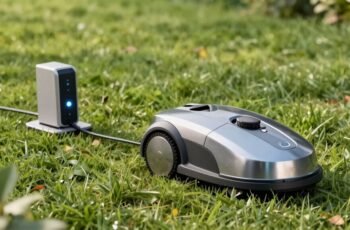
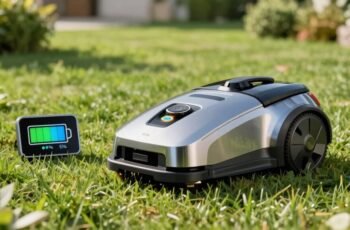
When evaluating robot lawn mowers, understanding their features is essential for making an informed choice. From boundary detection systems to navigation technologies, each component plays a vital role in performance and safety. We’ll explore how these systems work together to deliver a precise, efficient cut while ensuring safety and convenience. As we examine these details, you’ll gain insights into selecting the right model tailored to your yard’s unique requirements and terrain.
Key Takeaways
- Robot lawn mowers use boundary wires or GPS and sensors to define mowing areas and navigate around obstacles.
- They feature adjustable blades, high-capacity batteries, and larger cutting widths for efficient lawn coverage.
- Safety features include obstacle detection, lift/tilt sensors, and emergency stop functions to prevent accidents.
- Connectivity options like Wi-Fi and app control enable remote scheduling, monitoring, and smart home integration.
- Regular maintenance of blades, sensors, and batteries ensures optimal performance and longevity of the mower.
Understanding How Robot Lawn Mowers Work
While robot lawn mowers operate autonomously, understanding their underlying mechanics reveals a sophisticated integration of sensors, algorithms, and motor controls. These devices utilize boundary wires or GPS to define mowing areas, with sensors detecting obstacles, cliffs, and uneven terrain to prevent collisions and falls. The onboard microcontroller processes input from ultrasonic, infrared, and boundary sensors, executing algorithms that optimize mowing paths for efficiency. Motor controls drive the wheels and cutting blades, with brushless DC motors ensuring consistent power and durability. Real-time data from sensors enables adaptive navigation, while internal timers and boundary signals coordinate mowing schedules. This complex system allows the mower to operate independently, precisely maintaining the lawn while avoiding hazards through continuous feedback and dynamic path adjustment.
Key Features to Look for in a Robot Lawn Mower
When selecting a robot lawn mower, it’s vital to evaluate features that guarantee peak performance, safety, and convenience. Critical features include cutting system quality, battery capacity, and safety mechanisms. A robust cutting system with adjustable blades ensures precise, uniform cuts across various grass types. High-capacity batteries provide extended mowing times and faster recharge cycles, maximizing efficiency. Safety features such as obstacle detection, lift and tilt sensors, and anti-theft locks prevent accidents and unauthorized use. Additional key aspects include programmable schedules, weather resistance, and intuitive control interfaces. These technical elements ensure the mower operates reliably, maintains lawn aesthetics, and prioritizes user safety. Focusing on these features helps select a model that balances performance with durability, leading to long-term satisfaction and top-notch lawn care.
How Navigation Systems Enhance Mowing Efficiency
Navigation systems particularly improve the efficiency of robot lawn mowers by enabling precise, systematic coverage of the entire lawn area. Advanced algorithms, such as GPS and obstacle sensors, allow the mower to map the terrain and optimize path planning, reducing overlap and missed spots. This targeted approach minimizes mowing time and energy consumption.
| Navigation Method | Key Benefit |
|---|---|
| GPS-guided | Accurate boundary detection and route optimization |
| Obstacle Sensors | Real-time obstacle detection and avoidance |
| Boundary Wires | Defined perimeter for consistent coverage |
| LIDAR | 3D environment mapping for complex terrains |
These systems guarantee thorough, efficient mowing, reducing manual intervention and enhancing performance consistency.
Battery Life and Charging Capabilities Explained
Battery life and charging capabilities are critical factors that directly influence the operational runtime and overall efficiency of robot lawn mowers. High-capacity lithium-ion batteries typically provide longer mowing sessions, often ranging from 45 minutes to several hours depending on terrain and mower size. Fast-charging technology reduces downtime, enabling the mower to recharge in as little as 60-90 minutes. Additionally, smart charging docks utilize adaptive algorithms to optimize battery health over multiple cycles.
Key technical considerations include:
- Battery capacity (measured in Ah or Wh), which determines maximum runtime.
- Charge cycle longevity, affecting long-term performance.
- Automatic docking and recharging capabilities, ensuring continuous operation without user intervention.
Cutting Width and Blade Types for a Perfect Cut
Achieving a clean, even cut across your lawn depends heavily on selecting a robot mower with an appropriate cutting width and the right blade configurations. The cutting width determines mowing efficiency and the number of passes needed, affecting overall time and precision. Blade types vary: oscillating, rotary, or multi-blade systems, each influencing cut quality and grass health.
| Blade Type | Cutting Action | Best For |
|---|---|---|
| Rotary | Spin and cut grass | Thick, tall grass |
| Multi-blade | Fine, even cut | Residential lawns |
| Oscillating | Precise edging | Detailed trimming |
Choosing the right combination ensures suitable performance, clean cuts, and healthy turf.
Safety Features That Keep Your Yard and Family Safe
We incorporate obstacle detection sensors that continuously monitor the mower’s environment, halting operation if an object or person is detected. The emergency stop function provides an immediate shutoff mechanism activated manually or automatically in unsafe conditions. These features work together to guarantee safe operation around children, pets, and yard obstacles.
Obstacle Detection Technology
Obstacle detection technology is a critical safety feature that enables robot lawn mowers to navigate complex yard environments efficiently and securely. It uses a combination of sensors to identify objects, prevent collisions, and adapt the mower’s path in real-time. These sensors include ultrasonic, infrared, and bump sensors, each providing distinct data points for obstacle recognition. Ultrasonic sensors measure distance by emitting sound waves, infrared sensors detect heat signatures or reflectivity, and bump sensors activate upon physical contact, prompting immediate response. This multi-sensor approach guarantees thorough detection, reducing the risk of damage or injury. Effective obstacle detection relies on precise calibration, rapid data processing, and seamless integration of sensor inputs to maintain a safe and autonomous mowing experience without human intervention.
Emergency Stop Function
The emergency stop function is a essential safety feature that immediately halts the mower’s operation in response to hazardous conditions or user intervention. It is typically activated via a dedicated emergency stop button or sensor, which, when triggered, cuts power to the motor and halts blade rotation within milliseconds. This feature relies on a failsafe circuit that overrides normal operation, ensuring rapid response during emergencies. Advanced models incorporate infrared or touch sensors that detect physical interference, prompting an instant stop if an obstacle or person is detected. The system also interfaces with safety interlocks, such as cover or boundary wire sensors, to prevent accidental activation. Overall, the emergency stop function minimizes risk of injury or damage, providing a critical layer of safety during automated lawn care.
Connectivity and Smart Technology Integration
Modern robot lawn mowers leverage wireless connectivity to enable real-time updates and remote monitoring, enhancing operational efficiency. App control features allow users to schedule, customize, and troubleshoot mowing sessions with precision, reducing manual intervention. Additionally, seamless integration with smart home systems guarantees the mower can coordinate with other devices, optimizing yard management within a connected ecosystem.
Wireless Connectivity Capabilities
Wireless connectivity capabilities enable robot lawn mowers to seamlessly integrate with smart home systems and mobile devices, enhancing user control and automation. This integration relies on protocols such as Wi-Fi, Bluetooth, or Zigbee, allowing real-time data exchange and remote operation. These systems enable features like scheduled mowing, status notifications, and troubleshooting alerts directly through network connections. Additionally, advanced mowers can connect to cloud platforms, facilitating firmware updates and diagnostic analysis without manual intervention.
- Secure encrypted communication channels for data integrity
- Multi-protocol support for compatibility across different smart home ecosystems
- Low-latency connections ensuring immediate command execution and status updates
App Control Features
Have you ever wondered how effortlessly you can manage your lawn with just a few taps on your smartphone? App control features leverage Bluetooth, Wi-Fi, or cellular connectivity, allowing you to monitor and adjust your mower remotely. These apps typically include real-time status updates, scheduling options, and geofencing controls to prevent unauthorized access. They also enable firmware updates, ensuring peak performance and security. Here’s a detailed look at key functionalities:
| Feature | Description | Benefits |
|---|---|---|
| Remote Scheduling | Set mowing times via app | Precise control, flexibility |
| Geofence Alerts | Receive notifications upon boundary breaches | Security, safety |
| Maintenance Reminders | Automated alerts for blade replacement or cleaning | Longevity, performance |
Smart Home Integration
Integrating robot lawn mowers into smart home ecosystems enhances convenience and control by enabling seamless connectivity with various home automation platforms. This integration allows for real-time monitoring, scheduling, and remote operation through centralized systems. Advanced connectivity options include Wi-Fi, Zigbee, or Z-Wave protocols, ensuring compatibility with popular smart home hubs. Such integration supports features like voice commands, automation routines, and adaptive scheduling based on weather data or user preferences. To maximize efficiency, these systems often incorporate firmware updates over-the-air (OTA) and secure encrypted communication. By connecting to smart home platforms, users gain all-encompassing control and automation, reducing manual intervention. This interconnected approach streamlines lawn care, enhances security, and offers a unified smart home experience.
Maintenance and Troubleshooting Tips for Longevity
Regular maintenance is essential for ensuring our robot lawn mower operates efficiently and extends its lifespan. Regularly inspect and clean the cutting blades, removing debris and grass buildup to maintain ideal cutting performance. Check the wheel and track systems for wear or obstructions, ensuring smooth mobility. Keep the charging contacts clean to guarantee reliable power transfer. Troubleshoot connectivity issues by resetting the Wi-Fi module or Bluetooth connection, if applicable. Replace worn components promptly to prevent further damage. Below is a detailed maintenance checklist:
| Maintenance Task | Troubleshooting Tip |
|---|---|
| Clean and sharpen blades | Replace if dull or damaged |
| Inspect drive wheels and belts | Adjust or replace as needed |
| Clear debris from sensors | Use compressed air or soft brush |
| Check battery health | Replace if capacity drops considerably |
| Verify firmware updates | Install latest software for stability |
Choosing the Right Robot Lawn Mower for Your Yard Size
How do you determine the most suitable robot lawn mower size for your yard? First, assess your lawn’s total area, as mower capacity directly correlates with coverage efficiency. Second, consider terrain complexity—sloped or uneven grounds may require models with higher torque and wider cutting widths. Third, evaluate boundary systems and obstacle navigation capabilities to guarantee thorough coverage without missing sections or damaging surroundings.
When selecting, pay attention to:
- Cutting width: Larger widths reduce mowing time on expansive lawns.
- Battery capacity: Higher capacity models handle bigger areas without frequent charging.
- Navigation technology: Advanced sensors and GPS improve precision on complex terrains.
Matching these specifications to your yard’s size ensures optimal performance and longevity.
Frequently Asked Questions
How Weather Conditions Affect Robot Lawn Mower Performance?
Weather conditions can impact robot lawn mower performance by causing slipping on wet grass, reducing battery efficiency in cold temperatures, and risking damage from extreme heat or moisture; proper adjustments and maintenance help optimize operation under varying conditions.
Can Robot Mowers Handle Uneven or Sloped Terrain?
Yes, robot mowers equipped with adjustable blades, advanced sensors, and robust motors can handle uneven or sloped terrain; they navigate carefully, maintain stability, and adapt their cutting pattern to guarantee efficient, even mowing on challenging landscapes.
Are Robot Lawn Mowers Suitable for Thick or Tall Grass?
Yes, robot lawn mowers effectively handle thick or tall grass, equipped with powerful blades and adjustable cutting heights. They utilize sensors and adaptive algorithms to navigate dense vegetation, ensuring consistent, efficient mowing without clogging or damage.
What Is the Typical Lifespan of a Robot Lawn Mower?
We find that robot lawn mowers typically last 5 to 8 years, even with regular use. Proper maintenance, such as blade sharpening and battery care, considerably extends their lifespan, ensuring peak performance over time.
How Do I Update or Upgrade My Robot Mower’s Software?
We update our robot mower’s software through the manufacturer’s dedicated app or website, ensuring it’s connected via Wi-Fi. We download and install the latest firmware updates, which improve functionality and security, following detailed instructions provided.
Conclusion
In essence, selecting the right robot lawn mower is akin to wielding a precision tool, much like Da Vinci’s meticulous engineering. By understanding its features—navigation, battery life, safety, and connectivity—we guarantee ideal performance and longevity. Just as a finely tuned instrument produces perfect harmony, a well-chosen mower delivers a pristine lawn. Embrace these technical insights, and your yard will flourish, transforming maintenance from a chore into a symphony of efficiency.