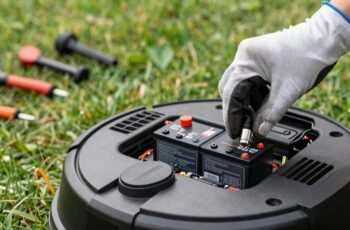
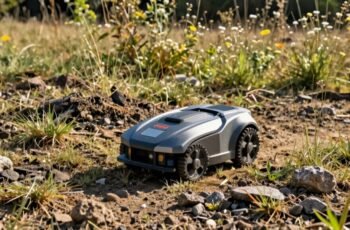
Choosing the right robot mower depends critically on understanding your lawn’s size and how it influences model selection. Precise matching guarantees ideal performance, efficiency, and longevity of the equipment. As lawn areas vary markedly, each size category presents unique requirements. To make an informed decision, it’s essential to assess these factors carefully. We’ll explore how to evaluate your yard and select the most suitable mower to meet your maintenance goals.
Key Takeaways
- Match mower size to lawn area: small models for up to 0.25 acres, larger for over 0.5 acres.
- Measure your lawn accurately to select a mower with appropriate cutting width and battery capacity.
- Larger lawns require mowers with extended runtime, GPS navigation, and obstacle detection features.
- For irregular or obstacle-rich terrains, choose smaller, agile mowers for better maneuverability.
- Upgrading or combining mowers can optimize coverage for extensive or varied lawn sizes.
How to Determine Your Lawn’s Size for Robot Mower Selection
To accurately select a robot mower, we must first determine the size of your lawn, as this measurement directly influences the mower’s capacity and battery life. The most precise method involves measuring the lawn’s length and width with a tape measure or laser distance meter, then calculating the total area in square feet or meters. For irregularly shaped lawns, divide the area into geometric sections, measure each, and sum the results. Alternatively, use online mapping tools or satellite imagery to obtain an estimate. Consistent measurement is essential for selecting a mower with appropriate cutting capacity and runtime. Accurate sizing guarantees peak performance, prevents underpowered units, and extends mowing intervals, ultimately maximizing efficiency and device longevity.
Small Lawns (Up to 0.25 Acres): What Robot Mower Features Matter
When selecting a robot mower for small lawns up to 0.25 acres, prioritizing specific features guarantees peak performance and efficiency. Essential features include compact size for maneuverability, reliable boundary wire detection, and programmable schedules for consistent mowing. Battery life should match lawn size to prevent interruptions, while sensors for obstacle detection enhance safety and reduce collisions. Connectivity options like app control enable precise adjustments remotely.
| Feature | Importance |
|---|---|
| Compact Dimensions | Ensures easy navigation in tight spaces |
| Obstacle Detection | Prevents damage and ensures safety |
| Battery Capacity | Supports continuous mowing for size match |
| Connectivity | Allows remote management and scheduling |
Medium Lawns (0.25 to 0.5 Acres): Choosing the Right Mower for Moderate Areas
For medium lawns, selecting a mower with adequate power guarantees effective cutting without overloading the system. Battery life becomes critical to cover the entire area efficiently, requiring models with extended runtime or fast charging. Balancing these factors optimizes performance and minimizes maintenance for moderate-sized landscapes.
Optimal Mower Power
Selecting the appropriate power level for a robot mower is essential for effectively maintaining medium-sized lawns ranging from 0.25 to 0.5 acres. For these areas, a mower with a motor power between 20 to 40 volts typically provides sufficient cutting torque and efficiency. Higher power ensures consistent performance on denser, thicker grass and prevents bogging down during prolonged operation. Precise motor specifications, such as blade torque and motor wattage, directly influence cutting ability and durability. It’s important to match the mower’s power output to the grass type and terrain complexity, avoiding underpowered units that struggle with thick patches. Proper power calibration guarantees ideal mowing quality, minimizes downtime, and enhances the mower’s longevity, making it a critical factor in selecting the right equipment for moderate lawns.
Battery Life Considerations
Have you considered how battery life impacts the effectiveness of a robot mower on medium-sized lawns? Battery capacity determines operational time before recharging, directly affecting mowing efficiency. For lawns between 0.25 and 0.5 acres, choose mowers with sufficient battery life to complete sessions without interruption.
| Battery Capacity | Mowing Time | Recharging Time |
|---|---|---|
| 1500mAh | 30-45 minutes | 1-2 hours |
| 2000mAh | 45-60 minutes | 1-2 hours |
| 2500mAh | 60-75 minutes | 1-2 hours |
Selecting a mower with higher capacity guarantees consistent coverage, minimizes recharge cycles, and optimizes overall lawn maintenance. Proper battery considerations prevent incomplete mowing sessions and reduce downtime.
Large Lawns (0.5 to 1 Acre): What to Look for in a Robot Mower
When managing large lawns that span between 0.5 and 1 acre, choosing a robot mower requires careful consideration of several key features to guarantee efficient and reliable operation. Essential attributes include high-capacity batteries with extended runtime to cover extensive areas without frequent recharge interruptions. Look for models with robust cutting systems capable of handling varied grass densities and terrain, including adjustable cutting heights. Navigation technology, such as GPS or all-encompassing boundary mapping, ensures precise coverage and minimizes missed spots. Additionally, reliable obstacle detection and avoidance systems prevent damage and enhance safety. Connectivity features like app control or scheduling integrations streamline operation management. Durability in weather-resistant construction and serviceability are also critical to sustain consistent performance over prolonged use in diverse environmental conditions.
Extra-Large Lawns (Over 1 Acre): Heavy-Duty Mowers and Multiple Units
Managing lawns over one acre often necessitates heavy-duty robot mowers or multiple units working in tandem to guarantee complete and efficient coverage. Heavy-duty mowers feature increased cutting width, higher battery capacity, and robust build quality for extended operation. When deploying multiple units, synchronization and boundary management are essential to prevent overlap and assure uniform mowing.
| Mower Type | Key Features |
|---|---|
| Heavy-Duty Mowers | Large cutting width, high battery life, durable construction |
| Multiple Units | Coordinated navigation, boundary sensors, centralized control systems |
Choosing between these options depends on lawn complexity and desired maintenance frequency. Both approaches optimize efficiency, reduce manual labor, and maintain consistent lawn health over expansive areas.
Factors Beyond Size: Terrain, Obstacles, and Mower Capabilities
Beyond size, factors like terrain variability, obstacle complexity, and mower capabilities critically influence performance. We must consider how uneven surfaces and obstacles challenge navigation and require advanced obstacle detection and maneuvering skills. Additionally, evaluating mower power and features guarantees effective operation across diverse terrain conditions.
Terrain Variability Challenges
Terrain variability presents significant challenges that extend beyond a mower’s physical size, impacting its ability to operate efficiently. Uneven surfaces, slopes, and surface composition influence traction, stability, and cutting performance. Mowers must adapt to varied topographies to maintain consistent mowing quality. Here’s a breakdown of key terrain factors:
| Terrain Aspect | Impact on Mower Performance |
|---|---|
| Slope Gradient | Affects stability and risk of tipping |
| Surface Composition | Influences traction and wheel slip |
| Soil Moisture | Affects ground firmness and mower grip |
| Obstructions in terrain | Can cause damage or operational delays |
| Vegetation Density | Impacts cutting efficiency and navigation |
Understanding these elements guarantees appropriate mower selection and peak performance across diverse terrains.
Obstacle Navigation Skills
While size plays a crucial role in a robot mower’s ability to navigate, its obstacle navigation skills depend heavily on a combination of terrain understanding, sensor capabilities, and adaptive algorithms. Advanced sensors, such as lidar, ultrasonic, and infrared, enable real-time obstacle detection and proximity assessment, ensuring precise maneuvering. Terrain understanding involves analyzing surface variations and obstacle types, allowing the mower to adjust its path accordingly. Adaptive algorithms process sensor data continuously, facilitating obstacle avoidance, path recalculation, and recovery from unexpected obstructions. These integrated systems enable efficient navigation even in complex environments with varied obstacles, such as garden furniture, trees, or uneven terrain. Consequently, obstacle navigation relies on sophisticated sensor integration and intelligent programming beyond mere physical dimensions, ensuring reliable performance in diverse lawn conditions.
Mower Power and Features
Size and obstacle navigation capabilities considerably influence a robot mower’s effectiveness, but their overall performance also depends on power and feature sets that enhance adaptability. Motor power determines cutting efficiency, especially on thicker or denser grass, while battery capacity affects runtime and mowing coverage. Advanced mowers incorporate features such as adjustable cutting heights, multiple mowing modes, and sensor-based obstacle detection to optimize operation across varied terrains. Some units include all-wheel-drive systems, ensuring better grip on uneven surfaces, and programmable schedules for precise mowing patterns. Additionally, integrated Wi-Fi connectivity allows remote monitoring and customization. These capabilities collectively expand a mower’s operational flexibility, ensuring consistent performance regardless of terrain complexity or lawn size, while maximizing efficiency and minimizing user intervention.
How to Match Mower Size With Your Lawn Maintenance Goals
Selecting the appropriate mower size is essential for achieving your specific lawn maintenance goals, as it directly impacts efficiency, cut quality, and operational ease. To match mower size with your objectives, consider lawn area, desired mowing frequency, and terrain complexity. Larger mowers are suited for extensive, flat lawns requiring minimal maneuvering, while smaller mowers excel in irregular or obstacle-rich areas requiring precision. The following table summarizes key matches:
| Lawn Area | Mower Size | Maintenance Goal |
|---|---|---|
| Up to 1,000 sq ft | Small (up to 7 inches) | Spot treatments, detail mowing |
| 1,000–3,000 sq ft | Medium (7–10 inches) | Regular, efficient maintenance |
| 3,000–5,000 sq ft | Large (10+ inches) | High-volume, low-frequency mowing |
| Irregular terrain | Small or adjustable | Precision navigation |
| Open, flat terrain | Large, fixed blades | Fast, uniform coverage |
Tips for Upgrading or Combining Mowers for Larger or Complex Lawns
Upgrading or combining mowers can considerably enhance your lawn maintenance efficiency when managing larger or more complex landscapes. To guarantee effective integration, assess each mower’s cutting width, battery capacity, and navigation capabilities. Opt for models with overlapping coverage areas to minimize gaps and ensure uniformity. When combining multiple units, synchronize their control systems through centralized software to optimize scheduling and prevent collisions. Consider modular configurations that allow for scalable expansion as your lawn grows. Maintain consistent blade types and cutting heights across units to achieve a uniform appearance. Additionally, evaluate terrain complexity—hills, obstacles, and narrow passages—and select mowers with appropriate traction and navigation features. Proper planning and technical compatibility are essential for seamless operation, maximizing coverage, and reducing maintenance time.
Frequently Asked Questions
How Does Lawn Shape Influence Robot Mower Size Selection?
Lawn shape influences robot mower size selection because irregular or complex boundaries require smaller, more maneuverable models, while larger, open lawns accommodate bigger mowers. We consider shape to optimize efficiency and coverage, avoiding obstacles and ensuring even mowing.
Can Robot Mowers Handle Uneven or Hilly Terrains Effectively?
Think of robot mowers as skilled navigators; they handle uneven terrain with specialized sensors and adaptive algorithms, ensuring precise operation on hills and slopes, though terrain complexity may influence performance and require specific model features for maximum efficiency.
What Safety Features Are Essential for Larger Mower Models?
We believe essential safety features for larger mower models include obstacle detection sensors, emergency stop buttons, anti-tip mechanisms, and boundary wire systems to prevent accidental exits and guarantee safe operation on varied terrains.
How Often Should I Service or Maintain My Robot Mower?
We recommend servicing your robot mower every 1-3 months, depending on usage and environmental conditions, to guarantee peak performance. Regular maintenance includes blade inspection, battery checks, and cleaning to prevent malfunctions and prolong its operational lifespan.
Are There Eco-Friendly or Energy-Efficient Robot Mower Options Available?
Yes, there are eco-friendly robot mowers with energy-efficient batteries, solar charging options, and reduced emissions. We recommend researching models with high energy efficiency ratings and sustainable features to minimize environmental impact while maintaining ideal lawn care performance.
Conclusion
While selecting the perfect robot mower based on lawn size seems straightforward, it’s amusing how often overlooked factors like terrain and obstacles can turn a simple choice into a complex puzzle. Ironically, the most expensive or powerful model isn’t always the best fit. Precision and understanding your specific yard conditions are key. So, before investing, make sure your mower’s capabilities truly align with your lawn’s unique demands—because size isn’t everything in the world of robotic lawn care.