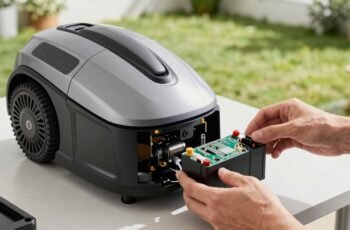
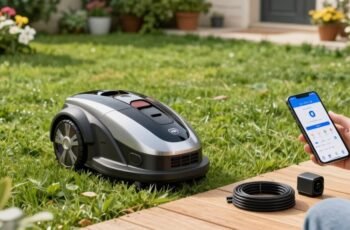
When it comes to maintaining robot lawn mowers, battery issues are a common concern that can markedly impact performance. We recognize that identifying the root causes, such as overcharging or temperature exposure, requires a precise approach. Recognizing early signs and understanding proper troubleshooting steps are essential for avoiding costly replacements. As we explore these problems, you’ll discover how to optimize battery longevity and prevent future failures, which might just change how you manage your equipment.
Key Takeaways
- Battery degradation from deep discharges, overcharging, and temperature extremes reduces runtime and efficiency.
- Signs of battery problems include shorter mowing time, longer charging, overheating, and visible swelling.
- Regular testing and maintenance help identify capacity loss and extend battery lifespan.
- Proper charging practices and storing in cool, dry environments prevent premature battery failure.
- Replacing batteries or upgrading equipment may be necessary if performance declines significantly.
Understanding Common Causes of Robot Lawn Mower Battery Problems
Understanding the common causes of robot lawn mower battery problems is essential for diagnosing and preventing performance issues. Most issues stem from factors such as repetitive deep discharges, which accelerate battery degradation by stressing the cells. Overcharging can also harm the battery’s lifespan, especially if the charger lacks proper regulation, leading to thermal stress and capacity loss. Environmental conditions, including exposure to extreme temperatures, further accelerate chemical deterioration within the cells. Additionally, internal corrosion and poor contact points can create resistance, reducing efficiency. Manufacturing defects, such as faulty cell assembly or imbalanced cells, contribute to early failure. Regular usage without proper maintenance, like cleaning contacts and avoiding prolonged inactivity, exacerbates these issues. Understanding these causes helps us develop preventive strategies to extend battery longevity and maintain ideal mower performance.
Signs Your Robot Mower’s Battery Might Be Failing
When a robot mower’s battery begins to decline, several telltale signs can indicate that its capacity and health are deteriorating. Reduced runtime is a primary indicator, as the mower struggles to complete full sessions. Increased charging time can also signal declining battery efficiency, requiring longer periods to reach full charge. Additionally, inconsistent cutting performance may occur, with the mower stopping prematurely or failing to cover the entire area. Below is a table summarizing these signs:
| Sign | Description | Impact |
|---|---|---|
| Reduced runtime | Shorter mowing sessions than usual | Incomplete mowing tasks |
| Longer charging times | Increased duration to reach full charge | Delayed operation |
| Unexpected power loss | Sudden stops mid-operation | Reduced efficiency |
| Excessive heat generation | Battery or mower becoming unusually warm | Potential damage |
| Visible battery swelling | Physical deformation or bulging | Imminent failure |
How to Test Your Robot Mower Battery for Health
To accurately assess your robot mower’s battery health, we need to perform targeted tests that measure its capacity and performance. First, conduct a voltage test using a multimeter to determine the resting voltage when the battery is fully charged; a healthy battery typically reads near its nominal voltage. Next, perform a load test by running the mower until the battery discharges while monitoring voltage levels; a significant voltage drop indicates reduced capacity. Additionally, measure the runtime compared to specifications—if it’s substantially shorter, the battery’s capacity is compromised. Recording these data points allows us to evaluate whether the battery maintains proper voltage under load and retains sufficient capacity, providing a clear picture of its overall health.
Troubleshooting Battery-Related Issues in Your Robot Lawn Mower
After performing tests to evaluate your battery’s condition, the next step is diagnosing common issues that may cause performance problems. Identifying root causes helps optimize operation and extend lifespan. Here are key troubleshooting steps:
- Check for improper charging cycles – inconsistent charging can lead to reduced capacity and voltage fluctuations.
- Inspect for physical damage or corrosion – corrosion at terminals impairs electrical flow.
- Evaluate temperature effects – extreme cold or heat accelerates degradation and impacts performance.
- Assess battery age and cycle count – older batteries with high cycle counts typically experience capacity loss and increased internal resistance.
Best Practices for Maintaining Your Robot Mower Battery
Consistent maintenance is essential for maximizing the lifespan and performance of your robot mower’s battery. Regularly monitoring charge cycles helps prevent excessive depletion, which can degrade cell chemistry and reduce capacity over time. We recommend keeping the battery within ideal charge levels—typically between 20% and 80%—to minimize stress and prolong longevity. Avoid leaving the mower unused for extended periods; instead, store it in a cool, dry environment and perform partial charges periodically. Cleaning contact points and ensuring secure connections reduce resistance and prevent corrosion, which can impair performance. Additionally, adhering to manufacturer guidelines for charging routines and avoiding overcharging or deep discharges helps maintain battery health, ensuring reliable operation and extending service life.
When and How to Replace the Battery in Your Robot Mower
Typically, recognizing the need for a battery replacement hinges on observing a significant decline in the mower’s runtime or performance, despite proper maintenance. Once performance drops below operational thresholds, replacement becomes necessary. To determine the best timing and process:
- Assess Performance Metrics: Measure runtime against manufacturer specifications.
- Visual Inspection: Check for swelling, corrosion, or leakage on the battery.
- Voltage Testing: Use a multimeter to verify voltage levels align with original specifications.
- Replacement Procedure: Power down the mower, disconnect the battery securely, and follow manufacturer guidelines for installation of a new unit.
Proper timing ensures continuous operation, while precise handling minimizes damage. Regular diagnostics combined with these steps help maximize lifespan and performance.
Choosing the Right Replacement Battery for Your Robot Mower
Selecting the appropriate replacement battery requires careful attention to compatibility specifications, including voltage, size, and connector type. We must also evaluate capacity ratings to guarantee the new battery meets runtime expectations while considering proper charging protocols to prolong lifespan. Addressing these key points ensures maximum performance and longevity of your robot mower’s power system.
Battery Compatibility Tips
When replacing the battery in your robot lawn mower, confirming compatibility is crucial to maintain ideal performance and prevent damage. Proper matching involves verifying several key specifications:
- Voltage Rating: Confirm the replacement battery’s voltage matches the original to prevent electrical mismatches.
- Capacity (Ah): Choose a battery with similar or higher capacity to ensure runtime consistency without overloading the system.
- Connector Type and Polarity: Ensure the physical connectors align and polarity is correct to avoid wiring issues.
- Physical Dimensions: Verify the size and shape fit within the mower’s compartment without forcing or modifications.
Adhering to these compatibility criteria guarantees safe operation, preserves battery life, and maintains the mower’s overall functionality.
Key Capacity Considerations
Choosing a replacement battery with the appropriate capacity is essential for maintaining your robot mower’s performance and runtime. Capacity, measured in milliampere-hours (mAh) or ampere-hours (Ah), directly influences operational duration between charges. Higher capacity batteries offer extended mowing periods but may increase weight and size, potentially affecting maneuverability. Conversely, lower capacity options might reduce weight but lead to more frequent charging cycles, disrupting mowing schedules. It’s critical to match the battery’s capacity with your mower’s power requirements and operational expectations. An undersized battery limits runtime, risking incomplete coverage, while an oversized one might strain the mower’s electrical system or exceed design specifications. Careful assessment of your mower’s power demands and typical usage patterns ensures suitable capacity selection for consistent performance.
Proper Charging Practices
Have you ever wondered how proper charging practices can extend the lifespan and maximize the performance of your robot mower’s battery? Correct procedures minimize degradation and prevent premature failure. To achieve this, follow these key practices:
- Use the recommended charger voltage and current to avoid overcharging or undercharging, which can damage the battery’s chemistry.
- Avoid deep discharges; recharge before the battery drops below 20% capacity to prevent stress on the cells.
- Keep charging cycles consistent, ideally at 80-90% capacity, to maintain excellent cell balance.
- Store batteries in a cool, dry environment if not in use, as temperature fluctuations accelerate chemical degradation.
Implementing these practices ensures the battery remains efficient, prolongs its lifespan, and maintains consistent operational performance.
Cost Considerations for Battery Replacement vs. Upgrading Your Mower
Deciding whether to replace a robot lawn mower battery or upgrade the entire unit hinges on a careful cost-benefit analysis. Battery replacement typically involves lower immediate expenditure, often ranging from $50 to $150, depending on capacity and compatibility. However, recurring replacements can accumulate over time, especially if the mower’s technology becomes outdated. Upgrading to a newer model entails higher upfront costs, usually between $300 and $700, but offers enhanced features, improved efficiency, and longer lifespan. When evaluating costs, consider the mower’s remaining operational lifespan, battery performance decline, and overall technological obsolescence. A thorough analysis weighs initial investment against long-term savings, maintenance costs, and potential productivity gains, enabling an informed decision aligned with both budget constraints and functional requirements.
Tips to Extend the Life of Your Robot Mower Battery
Proper charging practices and regular battery maintenance are critical for maximizing lifespan and performance. Adhering to recommended charging cycles prevents capacity loss, while routine inspections identify issues early. Implementing these strategies guarantees ideal battery health and reduces long-term replacement costs.
Proper Charging Practices
To maximize the lifespan of your robot mower’s battery, it’s essential to follow disciplined charging practices. Proper techniques reduce capacity loss and thermal stress, ultimately extending operational longevity.
- Avoid frequent partial charges: Fully charging and discharging the battery periodically helps maintain ideal cell chemistry.
- Use manufacturer-recommended chargers: Compatibility ensures correct voltage and current, preventing overcharging or undercharging.
- Charge in a cool environment: Excessive heat accelerates chemical degradation; charging in a stable, cool setting preserves battery health.
- Don’t leave the battery at 0% or 100% for extended periods: Maintaining a mid-range charge (around 40-80%) minimizes stress and capacity fade over time.
Adhering to these practices ensures consistent performance and prolongs the effective lifespan of your robot mower’s battery.
Regular Battery Maintenance
Have you ever wondered how small adjustments in routine maintenance can considerably extend your robot mower’s battery life? Regular battery care maximizes performance and prolongs lifespan. Consistent cleaning of contacts prevents corrosion, guaranteeing efficient power transfer. Monitoring charge cycles helps avoid deep discharges, which can degrade battery capacity over time. Implementing scheduled firmware updates can improve battery management algorithms, enhancing efficiency.
| Maintenance Step | Benefit |
|---|---|
| Cleaning contacts regularly | Maintains excellent electrical connection |
| Avoiding deep discharges | Extends overall battery lifespan |
| Firmware updates | Ensures advanced battery management |
Preventative Measures to Avoid Future Battery Problems
Implementing routine maintenance practices can substantially reduce the risk of battery degradation in robotic lawn mowers. To maximize battery longevity, consider these preventative measures:
Routine maintenance extends robotic mower battery life and ensures consistent performance.
- Regularly calibrate the battery system to ensure accurate charge and discharge cycles.
- Keep charging contacts clean and free of debris to maintain efficient electrical connections.
- Avoid overcharging or deep discharges by monitoring charge cycles and disconnecting once fully charged.
- Store the mower in a temperature-controlled environment during off-season, preventing thermal stress that accelerates battery wear.
These steps help mitigate common causes of battery failure by maintaining ideal operating conditions, promoting consistent performance, and extending overall battery lifespan. Adopting these technical strategies ensures reliability and reduces long-term maintenance costs.
Frequently Asked Questions
How Long Does a Typical Robot Lawn Mower Battery Last?
A typical robot lawn mower battery lasts between 1 to 3 years, depending on usage and maintenance. We analyze battery capacity, cycle life, and environmental factors to predict longevity, ensuring peak performance and timely replacements.
Can I Upgrade My Mower’s Battery for Better Performance?
Yes, you can upgrade your mower’s battery, but it requires verifying compatibility, voltage, and capacity. We recommend consulting the manufacturer’s specifications and possibly professional assistance to guarantee safe, ideal performance improvements without damaging your device.
Are There Eco-Friendly Battery Options Available?
Yes, eco-friendly batteries like lithium iron phosphate (LiFePO4) are available, offering reduced environmental impact, longer lifespan, and safer chemistry. We analyze these options carefully to guarantee sustainable performance, aligning with eco-conscious gardening practices.
How Does Temperature Affect Battery Lifespan?
Extreme temperatures, whether scorching or freezing, drastically shorten battery lifespan by accelerating chemical degradation or causing internal damage. We analyze these effects carefully, emphasizing ideal temperature ranges to maximize battery efficiency and longevity in robotic lawn mowers.
What Warranties Are Offered on Replacement Batteries?
We typically offer a one-year warranty on replacement batteries, covering manufacturing defects and performance issues. Our warranties guarantee reliability, but conditions vary by manufacturer, so it’s crucial to review specific terms for each product.
Conclusion
In essence, understanding and maintaining our robot mower batteries requires vigilance and proactive care. Regular checks, proper storage, and timely replacements help us avoid costly downtimes. As the saying goes, “A stitch in time saves nine,” emphasizing that early intervention can prevent larger issues. By applying these technical insights and best practices, we can optimize battery performance and extend our mower’s lifespan, ensuring efficient, reliable yard maintenance for years to come.