When it comes to maintaining our lawns, choosing between a robot mower and a push mower can considerably impact our outdoor routines. Each option offers distinct advantages, but understanding which fits best with our yard size, budget, and lifestyle isn’t always straightforward. As we weigh convenience against control, considering long-term costs and environmental impact, we find ourselves at a crossroads. Let’s explore these differences to see which mower might truly meet our gardening needs.
Key Takeaways
- Robot mowers operate autonomously, while push mowers require manual effort and control.
- Suitable for different lawn sizes: both work for small lawns, but large areas favor robot or riding mowers.
- Robot mowers typically have higher upfront costs but lower long-term maintenance expenses.
- Robot mowers are more convenient and user-friendly, especially for busy schedules or physical limitations.
- Electric robot mowers are environmentally friendly, producing no emissions and consuming less energy than gas-powered push mowers.
How Do Robot Mowers and Push Mowers Differ?
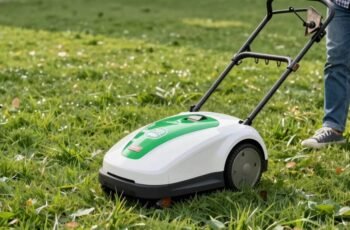
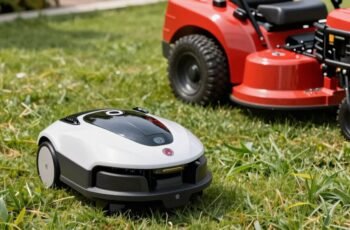
Robot mowers and push mowers differ mainly in how they operate and their level of automation. Robot mowers are autonomous; once set up, they clean your lawn on their own, steering around obstacles with sensors and programmable schedules. They require minimal human intervention, making lawn care more hands-off. Push mowers, on the other hand, are manual devices that you operate by pushing across the grass, giving you direct control over cutting height and coverage. They demand active effort from you but offer immediate, precise control. While push mowers are straightforward and require no power setup beyond fuel or cord, robot mowers rely on batteries and electronic systems. Fundamentally, their core difference lies in automation—robot mowers work independently, whereas push mowers depend entirely on human effort.
Which Mower Is Best for Your Lawn Size?
For small lawns, a push mower is often the easiest and most affordable choice. When it comes to larger areas, a robot mower offers an efficient solution that saves time and effort. Understanding your lawn size helps us decide which mower best fits your needs.
Small Lawns, Easy Choice
When it comes to small lawns, choosing the right mower is straightforward. For yards under 1,000 square feet, both robot mowers and push mowers work well, but each has advantages. Robot mowers are ideal because they’re quiet, automatic, and require minimal effort. You can set them to mow regularly, keeping your lawn perfectly trimmed without lifting a finger. Push mowers, on the other hand, are simple, affordable, and easy to maneuver, especially if you prefer a bit of exercise. For tiny lawns, a lightweight push mower might be the most cost-effective choice, offering quick, direct mowing. Ultimately, if convenience and automation appeal to you, a robot mower is the better fit. But if you value simplicity and control, a push mower gets the job done efficiently.
Large Lawns, Efficient Solution
As lawns grow larger, efficiency becomes a key factor in choosing the right mower. For expansive areas, a push mower can be tiring and time-consuming, making a robot mower or a riding mower more practical options. Robot mowers are excellent for maintaining large lawns with minimal effort; they work quietly, automatically, and can be scheduled to mow frequently, keeping your grass neat without much input. Riding mowers, on the other hand, cover ground quickly and are suitable for very large properties, especially if the terrain is uneven or has obstacles. Both options save time and reduce physical strain, but the choice depends on your lawn’s size, terrain, and your budget. Ultimately, for large lawns, investing in either a robot mower or a riding mower offers a highly efficient solution.
Are Robot Mowers More Affordable Over Time?
While robot mowers often have higher upfront costs, they can become more affordable over time due to lower maintenance and operational expenses. Unlike push mowers, which require regular fuel, oil, and blade replacements, robot mowers run on rechargeable batteries and need minimal upkeep. They don’t require physical effort or frequent repairs, saving you money and time. Additionally, their precise mowing pattern prevents overuse of power and reduces wear and tear, extending their lifespan. Over the years, these savings on fuel, repairs, and labor can outweigh the initial investment. Plus, their ability to operate autonomously means you save on mowing services or manual labor. Overall, while the initial purchase might be steep, robot mowers can be more cost-effective in the long run.
Which Mower Is Easier and More Convenient to Use?
Choosing between a robot mower and a push mower often comes down to convenience and ease of use. Robot mowers are incredibly user-friendly; once programmed, they operate automatically, saving you time and effort. You don’t need to push, pull, or maneuver, making them ideal for those with physical limitations or busy schedules. In contrast, push mowers require manual effort and some skill to operate efficiently. Setting up and maintaining a push mower can be more involved, but it offers more control over mowing patterns and adjustments. Overall, if you value simplicity and saving time, a robot mower is more convenient. However, if you prefer direct control and don’t mind the effort, a push mower can be just as manageable with the right routine.
Which Mower Is More Environmentally Friendly?
When it comes to environmental impact, electric robot mowers generally have a smaller carbon footprint than traditional gas-powered push mowers. They run on rechargeable batteries, which produce no emissions during operation, unlike gas mowers that emit greenhouse gases. Additionally, robot mowers tend to be more energy-efficient, conserving electricity through smart scheduling and low power consumption. Gas mowers, on the other hand, require fuel, which releases pollutants and contributes to air pollution. Maintenance is also greener with robot mowers, as they don’t need oil changes or spark plug replacements. Overall, if reducing your environmental impact is a priority, robot mowers are the more eco-friendly option, helping you maintain your lawn while minimizing your carbon footprint.
How to Choose the Right Mower for Your Gardening Lifestyle
Finding the right mower for your gardening lifestyle depends on understanding how you care for your lawn and what features matter most to you. Think about your mowing habits, lawn size, and how much time you want to spend maintaining your yard. Do you prefer automation or manual control? Are you looking for eco-friendly options or maximum power? To help decide, consider these factors:
Choose the right mower by considering your lawn size, maintenance habits, and preferred features.
- Lawn size and complexity
- Frequency of mowing
- Budget and long-term costs
- Desired level of automation and features
Frequently Asked Questions
How Long Do Robot Mowers Typically Last Before Needing Replacement?
Typically, robot mowers last around 5 to 8 years before needing replacement, depending on usage, maintenance, and brand quality. We find proper care and regular updates can extend their lifespan considerably for a better investment.
Can Push Mowers Handle Uneven or Hilly Terrain Effectively?
Like skilled mountain climbers, push mowers can conquer uneven, hilly terrain with determination, adapting to slopes and rough patches. We find they handle challenging landscapes well, making them reliable companions for varied yard terrains.
Do Robot Mowers Require Regular Software Updates?
Yes, robot mowers do require regular software updates. We recommend keeping their software current to guarantee peak performance, fix bugs, and access new features, much like updating any smart device for improved functionality and security.
What Safety Features Do Robot Mowers Have?
Did you know that over 80% of robot mowers include safety features? They have sensors to detect obstacles, automatically stop when lifted, and boundary wires to keep your lawn safe, ensuring peace of mind during mowing.
How Noisy Are Push Mowers Compared to Robot Mowers?
Push mowers are markedly noisier than robot mowers, often reaching 85-100 decibels, which can be disruptive. Robot mowers operate quietly, usually around 60 decibels, making them more suitable for peaceful yard maintenance.
Conclusion
So, whether you’re dreaming of a robot army mowing your lawn while you sip lemonade or prefer the humble push mower that demands your sweat and tears, the choice is yours. One’s a futuristic drone, the other a nostalgic workout. Either way, your lawn’s about to get the royal treatment—without a throne, just some grass and a little bit of your sanity. Happy mowing, no matter which side you choose!