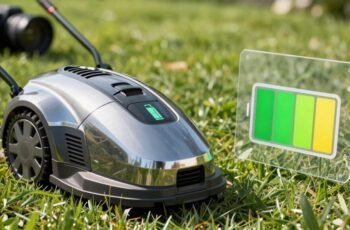
Studies show that most robot mowers return to their charging stations within 15 seconds of detecting low battery levels, highlighting the efficiency of their navigation systems. These devices rely on precise sensors and algorithms to guarantee seamless recharging, but understanding how this process works can greatly impact their longevity and performance. As we explore the intricacies of the charging cycle, you’ll discover how each component plays a vital role in maintaining peak operation—and why careful maintenance matters.
Key Takeaways
- Robot mowers monitor battery levels using voltage, current, and capacity sensors to determine when to return for charging.
- When battery drops below a threshold, navigation algorithms guide the mower back to the charging station.
- The station’s charging contacts establish a secure electrical connection for power transfer.
- Charging involves regulated current and smart algorithms to optimize battery health and lifespan.
- Troubleshooting and maintenance ensure efficient charging, involving contact cleaning, firmware updates, and battery health checks.
How Do Robot Mowers Know When to Return to Charging Station?
Robot mowers rely on a combination of sensors and internal algorithms to determine when to return to their charging stations. They continuously monitor their battery levels through integrated voltage sensors that measure power consumption in real-time. When the battery drops below a predefined threshold, the onboard microcontroller activates the navigation algorithm to locate the docking station. The mower’s sensors, such as boundary wires, proximity detectors, and obstacle sensors, assist in precise navigation toward the station’s location. Advanced models incorporate GPS or RF communication to enhance positional accuracy. The algorithms optimize the return path based on obstacle detection, terrain, and spatial constraints. Once the mower reaches the station, it executes a docking protocol to connect with the charging contact points, ensuring reliable power transfer.
Understanding the Charging Station and Its Components
Understanding the charging station and its components is essential for comprehending how robot mowers maintain continuous operation. The station serves as the power hub and communication point, facilitating the mower’s return, charging, and readiness. The primary components include the charging contacts, which connect with the mower’s pads; the power supply, providing necessary voltage; and the communication interface, enabling data exchange. The table below summarizes these core parts:
| Component | Function | Description |
|---|---|---|
| Charging Contacts | Establish electrical connection | Metal pads on station and mower for charging |
| Power Supply | Provides electrical energy | Converts mains power to suitable voltage |
| Communication Module | Data exchange | Sends signals for navigation and status |
This setup guarantees precise alignment and efficient energy transfer, critical for excellent operation.
How Robot Mowers Detect Low Battery Levels
Robot mowers utilize battery level sensors to monitor their remaining charge with high accuracy. These sensors communicate the battery status through specific signal methods, such as analog voltage or digital communication protocols. Understanding these mechanisms is essential for optimizing the mower’s ability to initiate the charging cycle efficiently.
Battery Level Sensors
How do robot mowers accurately detect when their batteries are running low? They rely on integrated battery level sensors that monitor voltage, current, and capacity in real time. These sensors constantly measure the electrical parameters of the battery, providing precise data about its state of charge. Voltage sensors detect the electrical potential difference, while current sensors track the flow of energy during operation and charging. Many models also incorporate Coulomb counting, which estimates remaining capacity by integrating current over time. This combination of measurements guarantees accurate, immediate detection of low battery conditions. Once the sensor data indicates the battery has fallen below a predefined threshold—typically around 20%—the mower’s control system triggers the return-to-charging station protocol, initiating the charging cycle with reliable precision.
Signal Communication Methods
To accurately detect low battery conditions, robot mowers employ various signal communication methods between the mower’s control system and the charging station. Mainly, these methods include wired and wireless protocols. Wired methods utilize physical electrical contacts or conductive strips integrated into the charging station, which establish a direct electrical connection when the mower docks. Wireless communication often employs radio frequency (RF) signals, infrared (IR), or Bluetooth to transmit data regarding battery status. These signals enable the mower to inform the station of its power levels in real-time. Accurate detection relies on consistent signal exchange, allowing the control system to initiate the charging cycle promptly. The choice of communication method impacts reliability, responsiveness, and overall system robustness during low battery detection and subsequent charging initiation.
The Role of Boundary Wires and Sensors in Charging Navigation
Boundary wires and sensors are essential components that guide the mower back to the charging station efficiently. Boundary wires create an electromagnetic field or physical perimeter that the mower detects using embedded sensors, preventing it from crossing designated boundaries. These wires establish a virtual boundary, ensuring the mower operates within a defined area. Sensors on the mower detect signals emitted by the boundary wires or magnetic fields, allowing precise localization relative to the charging station. When the mower’s battery reaches a preset low threshold, it uses these signals to navigate directly toward the charging dock. This process involves real-time positional adjustments based on sensor feedback, ensuring an accurate and reliable return path. Proper installation and calibration of boundary wires and sensors are critical for ideal navigation and seamless charging cycle completion.
What Happens During the Charging Process?
During the charging process, the robot mower first detects the battery’s state using a specialized detection mechanism. Once the battery reaches a low enough level, the mower initiates charging by establishing a power transfer sequence with the station. This sequence involves precise communication protocols to guarantee efficient and safe energy transfer.
Battery Detection Mechanism
How does the mower’s system determine when the battery is sufficiently charged? It relies on a combination of voltage, current, and temperature sensors integrated into the charging circuitry. These sensors continuously monitor the battery’s status, providing real-time data to the control system. The detection mechanism involves these key steps:
- Voltage Thresholds: The system tracks voltage levels to identify when the battery approaches full charge.
- Current Reduction: A decrease in charging current indicates nearing capacity.
- Temperature Monitoring: Sensors detect temperature fluctuations to prevent overheating during full charge.
- State of Charge Calculation: The control module integrates sensor data to estimate remaining capacity accurately.
This precise detection guarantees ideal charging, prolonging battery life and safety.
Charging Initiation Process
When the system detects that the battery has reached a sufficient charge level, it initiates the charging process by engaging the charging circuitry and establishing a secure electrical connection with the charging station. This involves activating the charging contacts, which align with the station’s power terminals. The control unit verifies the connection integrity through resistance and voltage checks to prevent short circuits or incomplete contact. Once confirmed, the system switches to charging mode, disabling mowing functions to prevent electrical interference. The charging circuitry regulates current flow, ensuring a stable and controlled transfer of electrical energy. Throughout this process, the system monitors voltage, current, and temperature to maintain safety and efficiency. This precise control ensures effective charging conditions and prevents damage to the battery or internal components during power transfer.
Power Transfer Sequence
What exactly occurs during the power transfer sequence in a robot mower’s charging process? Once charging begins, the mower’s control system activates the power transfer, facilitating efficient energy flow from the station. The sequence involves these key steps:
- Connection Verification: The charging contacts establish a secure electrical connection, confirmed by system sensors.
- Current Regulation: The charger adjusts current output based on the battery’s state, preventing overcharging.
- Voltage Monitoring: Voltage levels are continuously monitored to ensure safe, ideal charging conditions.
- Charge Termination: When the battery reaches full capacity, the system reduces current, eventually disconnecting to prevent damage.
This precise sequence guarantees safe, efficient, and reliable charging, maintaining battery health and operational readiness.
How Robot Mowers Optimize Battery Life and Charging Cycles
Robot mowers employ sophisticated algorithms and hardware features to extend battery lifespan and improve charging cycles. They monitor battery voltage, temperature, and usage patterns in real-time, adjusting charging rates accordingly. Many models utilize smart charging techniques such as pulse charging or multi-stage charging, which reduce stress on battery cells and prevent overcharging. Additionally, they implement scheduled charging during off-peak hours, minimizing thermal stress. Power management systems regulate current flow to balance charge speed with longevity, ensuring minimal capacity degradation over time. These features collectively enhance battery health by preventing deep discharges and reducing cyclical wear. Ultimately, this precise control allows robot mowers to maintain peak performance, extend operational lifespan, and reduce maintenance needs, all while conserving energy and ensuring consistent mowing efficiency.
Common Issues With Robot Mower Charging and How to Troubleshoot
Despite the advanced algorithms and hardware features designed to maximize battery health, robot mowers can still encounter common charging issues that disrupt their operation. Identifying and troubleshooting these problems ensures minimal downtime.
- Charging Station Connectivity: Poor contact between the mower and charging station can prevent proper charging. Regularly clean contact points and verify alignment.
- Battery Degradation: Over time, batteries lose capacity, leading to incomplete charges. Testing voltage levels can confirm if replacement is necessary.
- Firmware Malfunction: Software glitches may interfere with charging cycles. Resetting or updating firmware often resolves communication errors.
- Power Supply Problems: Inconsistent or insufficient power supply can hinder charging. Inspect power cords, outlets, and circuit breakers for faults.
Addressing these issues with precise diagnostics restores maximum charging function efficiently.
Tips for Maintaining Your Robot Mower’s Charging System
To guarantee your robot mower maintains ideal charging performance, regular inspection and cleaning of key components are essential. Begin by examining the charging contacts and ensuring they are free of debris, dirt, and oxidation, which can impede electrical conductivity. Use a soft cloth or a non-abrasive brush combined with isopropyl alcohol for effective cleaning. Check the charging station’s alignment and secure connections; misalignment can cause charging faults. Inspect the charging cables for signs of wear or damage, replacing any frayed or broken wires immediately. Additionally, verify that the contact pins on the mower and station are free of corrosion. Regular maintenance of these elements ensures efficient electrical contact, reduces charging errors, and prolongs the lifespan of the mower’s charging system.
How to Maximize Efficiency of Your Robot Mower’s Charging Cycle
Maximizing the efficiency of your mower’s charging cycle requires refining both the hardware setup and operational parameters. Precise calibration ensures minimal energy loss during charging, while proper placement of charging stations reduces transit time. To improve efficiency, consider these key actions:
Optimize mower charging by calibrating hardware and positioning stations for quicker, more efficient power transfer.
- Position the charging station: Place it in a shaded, accessible location with minimal obstructions to facilitate quick docking.
- Adjust charging parameters: Fine-tune voltage and current settings according to manufacturer specifications to optimize power transfer.
- Maintain battery health: Regularly monitor battery status and replace aging batteries to prevent voltage inconsistencies that hinder charging.
- Schedule mowing during ideal conditions: Avoid extreme temperatures that can impair charging efficiency and battery performance.
Implementing these steps ensures faster charge times, reduced energy consumption, and prolonged battery lifespan.
Frequently Asked Questions
How Long Does a Typical Robot Mower Take to Fully Charge?
A typical robot mower takes about 45 minutes to 2 hours to fully charge, depending on the model’s battery capacity, age, and charging technology, ensuring peak performance and battery longevity during regular mowing cycles.
Can Robot Mowers Charge in Any Weather Conditions?
We can charge robot mowers in most weather conditions, but rain or extreme cold can cause issues. Think of it as walking through a storm—some conditions are manageable, while others might halt the process to protect the equipment.
Do Different Brands Have Varying Charging Cycle Durations?
Yes, different brands have varying charging cycle durations due to design, battery capacity, and charging technology differences; some may charge faster or slower, affecting overall efficiency and mowing schedules, so it’s crucial to take these factors into account when choosing a robot mower.
How Often Should I Replace the Charging Station Components?
We suggest replacing charging station components every 2-3 years, as studies show that wear and corrosion increase failure risk by 30%. Regular checks guarantee peak performance, preventing costly breakdowns and maintaining efficient robotic lawn care.
Are There Safety Features During the Charging Process?
Yes, our robot mowers incorporate safety features during charging, including automatic shut-off if abnormal conditions are detected, obstacle sensors to prevent accidents, and temperature monitoring to avoid overheating, ensuring a secure and reliable charging process for users.
Conclusion
In summary, mastering the robot mower’s charging cycle is as thrilling as watching paint dry—except with more sensors and less excitement. By understanding its intricate dance of voltage thresholds, boundary wires, and precise alignment, we guarantee our robotic lawn assistants stay happy and well-charged. After all, who wouldn’t want a perfectly maintained, battery-efficient mower that’s almost smarter than we are? Here’s to extending battery life—one meticulously calibrated charge at a time.