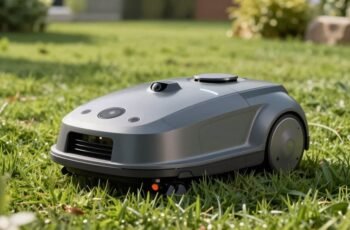
Just as a compass guides explorers through uncharted territory, GPS navigation in robot lawn mowers provides precise positioning within complex yard layouts. This technology forms the backbone of autonomous mowing, enabling efficient coverage, obstacle avoidance, and boundary adherence. Understanding how these systems operate and their limitations offers critical insight into optimizing lawn care automation. Exploring this topic further reveals how advancements could redefine the future of landscape maintenance and the challenges that lie ahead.
Key Takeaways
- GPS navigation in robot lawn mowers uses satellite signals and trilateration for precise location tracking within predefined boundaries.
- It enables efficient, systematic mowing by optimizing routes, reducing overlaps, and avoiding obstacles in real-time.
- Advanced features like RTK positioning and multi-sensor fusion improve accuracy and performance in challenging environments.
- Proper mapping and boundary detection ensure complete coverage and prevent areas from being missed or over-mowed.
- Future GPS advancements will enhance reliability, obstacle detection, and autonomous operation for better lawn care.
How GPS Navigation Works in Robot Lawn Mowers
GPS navigation in robot lawn mowers operates by utilizing satellite signals to determine the mower’s precise location within a designated area. The system relies on a network of global positioning satellites transmitting signals to the mower’s GPS receiver. When signals are received from multiple satellites, the onboard processor calculates the mower’s exact position through trilateration, analyzing the time delay of signals. This positional data is then integrated with pre-mapped boundary parameters, which define the mowing area. The GPS system continuously updates the mower’s location, allowing for dynamic path planning and obstacle avoidance. This precise geolocation capability enables the mower to execute systematic, accurate coverage patterns, minimizing overlaps and missed spots. The integration of GPS technology enhances operational efficiency and guarantees boundary compliance during mowing tasks.
Benefits of GPS-Guided Lawn Mowing
The integration of GPS-guided technology in lawn mowing considerably enhances operational accuracy and efficiency. This precision allows for systematic coverage, minimizing missed spots and reducing overlap, which optimizes energy consumption and battery life. GPS navigation enables autonomous operation with minimal human intervention, ensuring consistent mowing patterns regardless of terrain complexity. It also facilitates real-time adjustments based on environmental data, such as obstacle detection and boundary adherence, improving safety and reliability. Additionally, GPS-based systems support detailed mapping of the lawn area, aiding in maintenance planning and zone-specific mowing schedules. Overall, GPS-guided lawn mowers deliver a level of precision and operational consistency unattainable by traditional methods, leading to improved lawn quality, reduced operational costs, and enhanced user convenience.
Key Components of a GPS-Enabled Robot Mower
A robot mower equipped with GPS navigation relies on several key components that work together to guarantee accurate and autonomous operation. Central to its functionality are the GPS receiver, sensors, and onboard processor. The GPS receiver acquires satellite signals for precise positioning, while sensors—such as obstacle detection and boundary sensors—assure safe navigation. The onboard processor analyzes data, executes algorithms, and controls movement. The following table details these components:
| Component | Function | Importance |
|---|---|---|
| GPS Receiver | Acquires satellite signals for location | Core for navigation accuracy |
| Sensors | Detect obstacles and boundaries | Ensures safe operation and coverage |
| Onboard Processor | Processes data and controls movement | Coordinates system functions |
| Power Supply | Provides energy for all components | Maintains continuous operation |
How Robot Mowers Map and Cover Your Yard
Robot mowers utilize advanced mapping techniques such as boundary wire detection and GPS-based localization to create accurate yard layouts. Coverage algorithms, including grid and spiral patterns, optimize mowing efficiency and guarantee complete area coverage. Boundary detection methods, like ultrasonic sensors and perimeter wire signals, precisely define mowing limits to prevent overlap or exclusion.
Mapping Techniques Employed
How exactly do robot lawn mowers efficiently navigate and guarantee complete coverage of your yard? They utilize advanced mapping techniques that create a digital representation of the terrain. Some employ simultaneous localization and mapping (SLAM) algorithms, integrating sensor data from lidar, ultrasonic, or infrared sensors to develop accurate spatial maps. Others rely on boundary wires and boundary detection sensors to define the perimeter, combined with internal sensors to track movement. These methods enable the mower to establish a coordinate system, recording areas already mowed and identifying obstacles. Precise mapping assures systematic coverage, minimizes overlap, and prevents missed patches. This technical approach allows for optimized path planning and reliable operation, ultimately improving efficiency and guaranteeing the entire yard receives consistent, thorough mowing.
Coverage Algorithms Used
Coverage algorithms determine how robotic lawn mowers systematically traverse and mow your yard, ensuring no area is overlooked. These algorithms employ structured patterns such as back-and-forth or spiral paths to maximize efficiency and uniformity. Some mowers use grid-based approaches, dividing the yard into sections, then methodically covering each segment to minimize missed spots. Others incorporate randomized algorithms that adapt dynamically, reducing pattern predictability and improving coverage in irregularly shaped or obstacle-dense yards. Advanced models integrate sensor data and GPS signals to enhance routes, avoid overlaps, and reduce mowing time. The core goal of these algorithms is to balance thoroughness with energy efficiency, ensuring complete coverage while conserving battery life and minimizing mowing cycles. Precise coverage is essential for a uniformly cut lawn and peak mower performance.
Boundary Detection Methods
Boundary detection methods are essential for enabling robotic lawn mowers to accurately map the limits of a yard and prevent encroachment onto adjacent areas. These methods utilize various sensors and technologies to identify boundaries reliably. Infrared and ultrasonic sensors detect physical barriers, while boundary wires emit signals interpreted by the mower’s receiver, creating a virtual perimeter. Some models incorporate GPS data to supplement wire-based boundaries, enhancing accuracy in complex layouts. Advanced boundary detection employs camera vision or laser sensors, allowing the mower to recognize natural or artificial markers. The combination of these techniques ensures thorough boundary recognition, facilitating precise coverage and efficient navigation. Accurate boundary detection minimizes overlap, reduces mowing time, and prevents damage or trespassing, ultimately optimizing the mower’s operational effectiveness within designated areas.
Common Challenges and Limitations of GPS Navigation
While GPS technology has considerably advanced autonomous lawn mowing, it still faces several inherent challenges that can impact performance. Signal loss or degradation—due to dense foliage, tall structures, or adverse weather—can cause positional inaccuracies or navigation gaps. Multipath effects, where signals reflect off surfaces, introduce errors in positioning data, reducing precision. Additionally, GPS signals are susceptible to atmospheric disturbances, such as ionospheric delays, which can further compromise accuracy. Limited satellite visibility in obstructed environments can result in weak signals or loss of lock, impairing navigation. Reliance on external signals also introduces vulnerabilities, including potential jamming or interference. These limitations highlight the importance of supplementary sensors and fallback strategies to guarantee reliable, precise operation under diverse conditions.
Tips for Choosing the Right GPS Robot Lawn Mower
Selecting the appropriate GPS robot lawn mower requires verifying compatibility with your yard size to guarantee ideal coverage. We should also evaluate navigation technology features for accuracy and reliability, as well as battery life and charging times to maintain continuous operation. Prioritizing these factors enables an informed choice aligned with specific landscape and performance needs.
Compatibility With Yard Size
How well a GPS robot lawn mower adapts to your yard’s size is a crucial factor in guaranteeing efficient and reliable operation. Larger lawns require systems with extensive mapping capabilities, greater battery capacity, and robust navigation algorithms to cover the entire area without overlap or missed spots. Conversely, smaller yards benefit from compact models with streamlined mapping features that maximize cutting paths without unnecessary complexity. Compatibility hinges on the mower’s ability to process yard dimensions accurately, utilizing GPS precision and area-specific programming. It’s important to verify that the mower’s coverage capacity aligns with your yard’s size to prevent inefficiencies or incomplete mowing. Proper compatibility ensures the mower’s navigation system can maintain peak performance, conserving energy while providing thorough, uniform coverage.
Navigation Technology Features
Choosing the right GPS navigation features is essential for optimizing a robot lawn mower’s performance and reliability. Advanced navigation technology, such as real-time kinematic (RTK) positioning, enhances positional accuracy, minimizing overlaps and missed areas. Obstacle detection sensors, including ultrasonic or lidar systems, improve safety and efficiency by allowing precise obstacle avoidance. Mapping capabilities, such as grid or boundary mapping, facilitate tailored mowing patterns and area management. Multi-sensor fusion, combining GPS, inertial measurement units (IMUs), and proximity sensors, ensures consistent operation even in challenging conditions like dense foliage or signal interference. Additionally, firmware updates and customizable navigation algorithms enable continual optimization of mowing paths. Prioritizing these features guarantees precise, reliable, and efficient yard coverage, aligning with specific landscape complexities and user expectations.
Battery Life and Charging
Battery life and efficient charging are critical factors that directly influence the overall performance and operational continuity of GPS-enabled robot lawn mowers. Longer battery endurance allows for extended mowing sessions and reduces downtime, while rapid charging minimizes operational gaps. When selecting a mower, consider these key aspects:
- Battery capacity: Higher mAh ratings provide longer runtime, suitable for larger lawns.
- Charging time: Shorter charge cycles enhance productivity and reduce idle periods.
- Battery technology: Lithium-ion batteries offer better longevity and consistent performance.
- Power management system: Advanced systems optimize energy use, extending operational time.
A precise understanding of these components ensures the mower maintains reliable operation, especially in complex terrains or extensive lawns. Well-chosen batteries and charging systems are fundamental to maximizing efficiency and minimizing maintenance.
Future Trends in GPS Technology for Lawn Care
Advancements in GPS technology are poised to considerably enhance the precision and efficiency of robotic lawn mowers in the near future. We anticipate integration of multi-constellation GNSS (Global Navigation Satellite System) support, improving positional accuracy under diverse conditions. Real-time kinematic (RTK) positioning will become more prevalent, enabling centimeter-level precision, which allows for optimized mowing paths and minimized overlap. Additionally, geofencing and obstacle detection will leverage high-definition geospatial data, reducing collision risks. We also expect enhanced data processing algorithms and machine learning to refine navigation strategies dynamically, adapting to changing terrain and environmental factors. Together, these innovations will enable more autonomous, reliable, and efficient lawn care solutions, reducing manual oversight and increasing operational robustness in complex yard layouts.
Frequently Asked Questions
How Accurate Is GPS Navigation in Different Weather Conditions?
GPS navigation accuracy varies with weather; it’s generally precise in clear conditions but can degrade during heavy rain, snow, or thunderstorms, as signal interference increases, affecting positioning precision and reliability of robot lawn mower navigation.
Can Gps-Enabled Mowers Operate Without an Internet Connection?
GPS-enabled mowers can operate without internet, relying on onboard satellite signals and preloaded maps; however, they require initial setup data, and real-time updates or remote control features typically need internet connectivity for peak performance.
What Is the Typical Battery Life of GPS Robot Lawn Mowers?
GPS robot lawn mowers typically offer 60 to 120 minutes of operation per charge; advanced models with larger batteries can extend this up to two hours, optimizing coverage while balancing power consumption and mowing efficiency.
How Do GPS Systems Handle Yard Obstacles or Temporary Changes?
GPS systems detect yard obstacles through real-time mapping and sensor integration, dynamically adjusting routes. They recognize temporary changes via obstacle sensors, recalculating paths efficiently, ensuring thorough coverage while avoiding hazards and accommodating yard modifications.
Are GPS Features Compatible With All Robot Lawn Mower Brands?
GPS features are not universally compatible; they depend on the mower’s brand and model. We recommend checking manufacturer specifications to guarantee the specific GPS technology integrates seamlessly, as compatibility varies across different robotic lawn mower systems.
Conclusion
Like skilled navigators charting unseen waters, GPS in robot mowers guides each move with precision. As technology advances, our lawn care becomes an intricate dance of data and direction, minimizing overlaps and missed spots. Embracing these innovations means we’re steering toward smarter, more efficient landscapes. With every update, we refine our course, transforming routine mowing into a symphony of accuracy and reliability, ultimately leading us to a future where autonomous lawn care sails smoothly on the winds of progress.