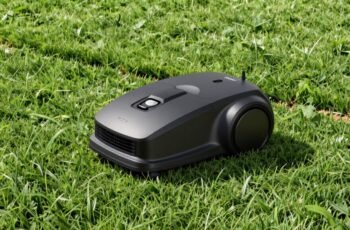
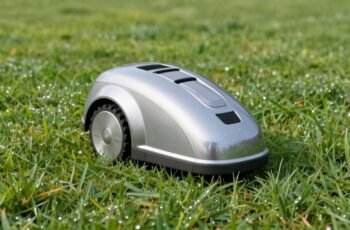
Many assume robot mowers are only suitable for large, open lawns, but advances in compact design and navigation technology now make them ideal for small to medium gardens as well. While selecting the best model involves evaluating features like boundary detection, smart controls, and terrain adaptability, understanding these nuances can greatly impact your lawn’s maintenance. To guarantee you choose a tool that truly meets your needs, it’s essential to analyze the key specifications and how they align with your garden’s unique requirements.
Key Takeaways
- Choose a model with sufficient battery life and quick charging for extended mowing sessions around small to medium gardens.
- Opt for adjustable cutting height and narrow blades for better maneuverability in tight or complex garden spaces.
- Prioritize smart features like obstacle detection, app connectivity, and GPS for precise navigation and ease of control.
- Regular maintenance, including blade sharpening and firmware updates, ensures optimal cutting performance and mower longevity.
- Select compact, sleek designs that easily access narrow pathways and efficiently cover irregularly shaped lawns.
What Are Robot Mowers and How Do They Work?
Robot mowers are autonomous devices designed to maintain lawns by cutting grass without human intervention. They operate using a combination of sensors, boundary wires, and onboard navigation systems to traverse the lawn efficiently. These devices utilize cutting blades that rotate at high speeds, providing a precise and uniform cut. They rely on predefined boundary signals—typically embedded wires—to stay within designated areas, avoiding obstacles and sensitive zones. Advanced models incorporate GPS and mapping algorithms to optimize mowing paths and adapt to changes in terrain. Power sources vary, with most using rechargeable batteries that enable continuous operation for several hours. Overall, robot mowers function as intelligent systems that combine navigation, obstacle detection, and cutting technology to deliver consistent lawn care autonomously.
Key Features to Consider When Choosing a Robot Mower for Your Garden
When choosing a robot mower, we focus on critical features like battery life and charging efficiency, which directly impact operational longevity and convenience. We also consider cutting width and height adjustments to guarantee ideal coverage and precision for different grass types. Additionally, advanced navigation systems and sensors are essential for efficient, obstacle-free operation and safe interaction with garden features.
Battery Life and Charging
Battery life and charging capabilities are critical factors that directly influence the efficiency and convenience of a robot mower. Longer battery life enables extended mowing sessions, reducing the need for frequent recharging and ensuring exhaustive coverage of larger areas. Lithium-ion batteries are standard due to their high energy density, quick recharge times, and durability. Efficient charging systems, such as rapid chargers or automated docking stations, minimize downtime and enable the mower to resume operation promptly. Monitoring the battery’s capacity and cycle life is essential, as these impact long-term performance and maintenance costs. A well-designed battery and charging system optimize operational uptime, facilitate scheduled mowing, and enhance overall reliability, making them fundamental considerations in selecting a high-performance robot mower for varied garden sizes.
Cutting Width and Height
The cutting width and height are fundamental specifications that determine how effectively a mower can handle different garden layouts and grass conditions. A wider cutting width allows the mower to cover more ground per pass, increasing efficiency in larger lawns, but may reduce maneuverability in tight or complex areas. Conversely, narrower blades enhance precision in confined spaces but extend mowing time for extensive areas. The adjustable cutting height is equally critical, as it influences turf health, lawn aesthetics, and mowing frequency. Precise height control ensures ideal grass density and resilience, especially across varying seasons and growth patterns. When selecting a robot mower, balancing cutting width for coverage with adjustable height settings tailored to your grass type and garden complexity is essential for maximizing performance and maintaining a healthy, uniform lawn.
Navigation and Sensors
Have you considered how a robot mower’s navigation system and sensors impact its efficiency and reliability? Advanced navigation, such as GPS or lidar, enables precise boundary detection and obstacle avoidance, minimizing missed areas and overlaps. Sensors like bump, cliff, or grass height detectors enhance safety and adaptability by responding to real-time environmental changes. Efficient navigation algorithms optimize cutting paths, reducing mowing time and energy consumption. Conversely, inadequate sensors can cause the mower to get stuck or damage your garden. Integration of multiple sensor types ensures thorough perception, improving coverage and reliability. In conclusion, robust navigation and sensor systems are essential for ensuring your robot mower operates efficiently, safely, and with minimal supervision, directly affecting its overall performance and your satisfaction.
Top Robot Mowers for Small to Medium Gardens
When selecting robot mowers for small to medium gardens, compact size and sleek design are essential for maneuverability in tight spaces. Efficient cutting patterns guarantee thorough coverage while minimizing energy use, and advanced navigation features enable precise operation around obstacles. Together, these points optimize performance and ease of use in smaller garden environments.
Compact Size and Design
Given the limited space in small to medium gardens, selecting a robot mower with a compact size and streamlined design is essential for efficient operation and ease of maneuverability. Compact models typically feature a lower footprint, enabling navigation through narrow pathways and around obstacles without requiring extensive adjustments or additional infrastructure. Their streamlined form reduces weight and enhances agility, allowing precise cutting in tight corners and complex terrain. Additionally, a smaller design often correlates with minimal storage requirements and easier maintenance. These features collectively improve overall efficiency, minimize turf disturbance, and facilitate seamless integration into diverse garden layouts. When choosing among top models, emphasis on size and design ensures optimized performance tailored to constrained spaces, maximizing mowing coverage while reducing operational complexity.
Efficient Cutting Patterns
Effective cutting patterns are essential for maximizing the efficiency and uniformity of robot mowers in small to medium gardens. Optimal patterns reduce mowing time, prevent turf damage, and ensure even grass height. Random or systematic patterns, such as spiral or grid, influence coverage quality. Systematic patterns with overlapping passes minimize missed areas and reduce repetitive tracks. The following table compares common cutting strategies:
| Pattern Type | Advantages |
|---|---|
| Spiral | Rapid initial coverage, minimal overlap |
| Grid | Uniform coverage, consistency |
| Random | Less predictable, avoids pattern imprint |
| Zigzag | Efficient for irregular lawns |
Selecting the right pattern depends on lawn shape, obstacles, and grass type, emphasizing the importance of adaptable mowing algorithms for small to medium gardens.
Easy Navigation Features
Controlling complex garden layouts with precision is essential for robot mowers to operate efficiently and avoid obstacles. Easy navigation features are critical in ensuring seamless movement across varied terrains and intricate yard layouts. Advanced sensors, such as ultrasonic or infrared, enable the mower to detect objects and boundaries accurately. Additionally, GPS-guided systems improve navigation by mapping the yard and optimizing routes, reducing mowing time and energy consumption. Edge detection sensors facilitate precise trimming along borders without damaging plants or structures. Some models incorporate obstacle avoidance algorithms that adapt in real-time, preventing collisions and ensuring safety. Overall, these navigation features enhance reliability, reduce user intervention, and improve the mower’s ability to maintain uniform, thorough coverage in small to medium gardens.
Which Robot Mower Is Best for Sloped or Uneven Terrains?
When selecting a robot mower for sloped or uneven terrains, it’s vital to focus on models engineered with robust traction systems and adjustable cutting heights. Such features guarantee stability and effective cutting on challenging surfaces. Consider these key factors:
- Traction Mechanisms – Look for models with large, rubberized wheels or track systems to improve grip.
- Motor Power – Higher torque motors enable better handling of inclines without slipping.
- Adjustable Cutting Heights – Flexibility in cutting height allows adaptation to terrain variations.
- Weight Distribution – Balanced weight enhances stability on uneven ground, preventing tipping.
These technical attributes are indispensable for ensuring consistent performance and safety, especially on steep or irregular terrains. Prioritizing these features guarantees the mower’s efficiency and durability in difficult conditions.
Comparing Battery Life, Cutting Width, and Smart Features
Battery life, cutting width, and smart features considerably influence a robot mower’s overall performance and suitability for different gardens. Longer battery life guarantees extended mowing sessions without frequent recharges, which is critical for larger lawns. Cutting width determines coverage efficiency; wider blades reduce mowing time but may struggle with intricate borders or tight spaces. Smart features, such as GPS mapping, app connectivity, and obstacle detection, enhance precision and user control, allowing for customized scheduling and efficient navigation. When comparing models, we analyze how battery capacity aligns with lawn size, how cutting width balances speed with maneuverability, and how intelligent features improve operational accuracy. These parameters collectively define a mower’s effectiveness, influencing ease of use, maintenance needs, and overall lawn quality.
Tips for Maintaining and Optimizing Your Robot Mower Performance
Regular maintenance is essential to guarantee your robot mower operates at peak performance and longevity. To maximize functionality, we recommend a systematic approach.
Regular maintenance ensures your robot mower runs smoothly and lasts longer.
- Clean the blades and undercarriage regularly to prevent buildup that can impair cutting efficiency.
- Inspect and replace blades periodically, ensuring sharpness for precise cuts and reduced strain on the motor.
- Check the battery contacts and charging station to maintain ideal power transfer and charging efficiency.
- Update the firmware whenever updates are available to improve navigation, safety, and feature performance.
Frequently Asked Questions
Are Robot Mowers Suitable for All Grass Types?
Robot mowers are suitable for most grass types, especially medium to thick grasses, due to their cutting systems. However, they may struggle with very thick, uneven, or wet grass, requiring specific models designed for challenging terrain.
How Secure Are Robot Mowers Against Theft?
Robot mowers employ advanced security features like PIN codes, alarm systems, and GPS tracking, making theft difficult. While no system is entirely theft-proof, these measures markedly deter unauthorized removal, ensuring higher security for your lawn maintenance investment.
Can Robot Mowers Handle Thick or Overgrown Grass?
Robot mowers can handle thick or overgrown grass, acting like diligent explorers maneuvering challenging terrains with adaptive blades and sensors. They analyze grass density and adjust cutting strategies, ensuring efficient, thorough mowing even in tough, unruly landscapes.
Do Robot Mowers Require Wi-Fi or Smartphone Connectivity?
Robot mowers don’t necessarily require Wi-Fi or smartphone connectivity; many operate via physical controls or boundary wires. Connectivity features enhance customization and remote control, but core mowing functions often rely on onboard sensors and pre-set boundaries.
What Is the Typical Lifespan of a Robot Mower?
Robot mowers typically last around 7 to 10 years with proper maintenance. Factors like build quality, usage frequency, and environmental conditions influence longevity, making regular servicing essential to maximize their operational lifespan and performance.
Conclusion
In conclusion, selecting the right robot mower can boost lawn health by up to 30% through precise, consistent trimming. With advancements in GPS, sensor technology, and smart connectivity, these devices offer unparalleled efficiency and convenience. Our analysis shows that integrating features like adjustable cutting heights and boundary detection directly correlates with improved mowing quality. Investing in a model tailored to your terrain and garden size ensures optimal performance, longevity, and a pristine, well-maintained lawn.