Did you know that robot mowers rely on sophisticated sensors and algorithms to determine the most favorable moment to return to their charging stations? These systems guarantee continuous operation and extend the lifespan of the device, but their effectiveness depends on precise navigation and proper setup. As technology advances, understanding how these mechanisms work can greatly enhance your mower’s performance and reliability. Let’s explore how these return-to-base functions operate and what factors influence their success.
Key Takeaways
- Robot mowers monitor battery levels continuously and initiate return to base when capacity drops below a set threshold.
- Navigation systems like GPS, boundary wires, or SLAM guide the mower back accurately.
- Sensors detect obstacles and environmental cues to ensure safe, efficient return paths.
- Proper station setup and maintenance improve signal reception and successful return.
- Environmental factors and sensor issues can cause return failures or delays.
How Do Robot Mowers Know When to Return to the Charging Base
Robot mowers determine when to return to their charging base primarily through a combination of battery monitoring and navigation systems. Integrated sensors continuously assess battery voltage and current flow, providing real-time data on charge levels. When the battery drops below a predetermined threshold, the mower’s onboard processor activates the return protocol. Simultaneously, navigation systems utilize GPS, boundary wire signals, or internal mapping algorithms to identify the most efficient route back to the dock. These systems coordinate to confirm timely arrivals, avoiding obstacles and optimizing pathfinding. Precise location tracking is maintained through a combination of inertial measurement units and external signals, allowing the mower to accurately navigate complex terrains. This integrated approach guarantees reliable and efficient return-to-base functionality, minimizing downtime and maximizing operational efficiency.
The Role of Battery Level in Return-to-Base Functionality
The battery level serves as the primary trigger for initiating the return-to-base process in autonomous mower systems. When the battery drops below a predetermined threshold—typically around 10-15%—the mower’s control system activates the return sequence. This threshold is calibrated to guarantee sufficient power for a safe return and docking procedure without risking complete power depletion. The system continuously monitors voltage levels and current draw to assess remaining capacity accurately. Once the threshold is reached, the mower halts mowing operations and switches to the return mode. This process prioritizes battery preservation, prevents operational failures, and maintains overall system reliability. Precise battery management is vital for optimizing performance and assure the mower’s autonomous functionality remains consistent over multiple cycles.
How Navigation Systems Guide Your Robot Mower Back Home
Navigation systems utilize advanced path planning techniques to efficiently direct the mower back to its charging station. Obstacle detection methods guarantee safe navigation by identifying and avoiding barriers in real-time. Return-to-base algorithms coordinate these functions to optimize routing accuracy and minimize energy consumption.
Path Planning Techniques
| Technique | Purpose |
|---|---|
| A* Algorithm | Finds shortest, most effective path |
| Dijkstra’s | Calculates minimal travel cost |
| Map Analysis | Determines ideal route based on data |
| Sensor Data | Adjusts path in real-time |
| Environmental | Adapts to terrain and slope |
Obstacle Detection Methods
Obstacle detection methods are critical for guiding robot mowers safely back to their charging bases by ensuring they can identify and respond to potential hazards in real-time. These methods utilize sensor technologies such as ultrasonic, infrared, and LiDAR to detect objects within the mower’s path. Ultrasonic sensors measure distance via sound waves, providing reliable proximity data, while infrared sensors detect heat signatures and reflectivity. LiDAR offers high-resolution mapping by emitting laser pulses and analyzing the reflected signals. The integration of these sensors enables the mower’s navigation system to create dynamic obstacle maps, facilitating immediate response to unexpected objects. Precise detection allows for timely obstacle avoidance maneuvers, reducing collision risks and ensuring safe, efficient return to the charging station.
Return-to-Base Algorithms
How do robot mowers accurately return to their charging bases? They rely on sophisticated Return-to-Base algorithms that integrate precise localization, path planning, and real-time sensor data. These algorithms utilize boundary signals, such as magnetic or radio frequency identifiers, to establish the mower’s position relative to the docking station. Once the battery reaches a predefined threshold, the system computes an ideal route, factoring in obstacles and terrain, to guarantee efficient navigation. Advanced models employ simultaneous localization and mapping (SLAM) techniques, combining odometry, inertial measurements, and environmental cues, to maintain spatial awareness. The control system then executes a dynamic, obstacle-aware trajectory, guiding the mower seamlessly back to its base, minimizing energy consumption and avoiding hazards.
Common Sensors Used to Detect When It’s Time to Head Back
We rely on various sensors to determine when the robot mower should return to its charging station. Cliff and obstacle detection sensors prevent falls and collisions, while boundary wire sensors define the mowing area. Battery level monitoring guarantees the mower returns promptly before power depletion.
Cliff and Obstacle Detection
Cliff and obstacle detection systems are essential components that enable robot mowers to identify when they need to return to their charging base. These sensors prevent accidents by detecting edges, drops, and obstructions, ensuring safe operation. Typically, they utilize various technologies for accuracy:
- Infrared sensors to detect sudden changes in surface reflectivity
- Ultrasonic sensors measuring distance to nearby objects
- Bump sensors that activate upon physical contact with obstacles
- Gyroscopes and accelerometers for orientation and movement assessment
Together, these sensors provide real-time data, allowing the mower to navigate complex terrains safely. By precisely identifying drop-offs and obstacles, they facilitate efficient operation and prevent damage or injuries, ultimately ensuring reliable return-to-base functionality.
Boundary Wire Sensors
Boundary wire sensors are a fundamental component in most robot mower systems, serving as the primary method for detecting the designated mowing area and triggering the return to the charging station. These sensors operate by emitting a low-voltage signal through a buried wire perimeter, creating an invisible boundary. The mower’s receiver detects this signal, allowing it to differentiate between the mowing zone and the boundary. When the mower approaches the wire, the sensors relay this information to the control system, prompting it to change direction or head back to the station. Precise installation and maintenance of the boundary wire are critical for reliable operation. Properly functioning sensors ensure the mower stays within the designated area and returns promptly when the charging cycle is complete or when boundary limits are reached.
Battery Level Monitoring
Battery level monitoring is a critical function that guarantees autonomous mower operation remains efficient and uninterrupted. It enables the mower to assess its remaining energy and determine the appropriate time to return for charging. Common sensors used include voltage sensors, coulomb counters, and current sensors, which provide real-time data on battery status. These sensors work together to guarantee precise detection of low battery conditions, minimizing downtime and preventing operation failures. Accurate monitoring also prolongs battery lifespan by preventing deep discharges.
- Voltage sensors measure the electrical potential difference directly across the battery terminals.
- Coulomb counters track the charge flow in and out, offering detailed capacity data.
- Current sensors monitor the flow of current during operation and charging cycles.
- Integrated control algorithms interpret sensor data to trigger return-to-base protocols efficiently.
Why Timely Returns Extend the Lifespan of Your Robot Mower
Timely returns to the charging base are essential for maintaining the ideal performance and longevity of your robot mower. Frequent charging cycles prevent deep discharges that cause battery stress and capacity loss over time. When the mower returns promptly, the battery operates within best voltage ranges, reducing strain on its cells. This consistent, controlled charging minimizes thermal fluctuations, which can accelerate component degradation. Additionally, maintaining proper charge cycles prevents overheating and reduces the risk of internal corrosion. By ensuring the mower returns before the battery reaches critically low levels, you limit the formation of solid electrolyte interfaces that impair battery efficiency. Overall, timely returns maximize battery health, delay capacity fade, and extend the operational lifespan of the entire robotic mowing system.
Troubleshooting: What Causes Your Robot Mower to Miss Its Return?
When a robot mower fails to return to its charging base, several technical issues could be at play. First, navigation sensors may be obstructed or malfunctioning, impairing pathfinding accuracy. Second, the charging station’s detection signals could be weak or disrupted, preventing proper recognition. Third, software glitches or outdated firmware might hinder the mower’s ability to identify the return point. Ultimately, environmental factors like thick vegetation or debris can interfere with sensor signals or obstruct the mower’s path.
- Obstructed or dirty sensors impair localization
- Weak or disrupted charging station signals
- Firmware or software malfunctions
- Environmental obstructions blocking signal reception
How to Optimize Your Lawn Layout for Better Return Accuracy
Optimizing your lawn layout is essential to improve your robot mower’s return accuracy, as obstacles and terrain variations can interfere with sensor signals and navigation. Start by removing or repositioning objects that block sensors, such as tall plants, garden furniture, or tools, guaranteeing clear pathways. Maintain a flat, even terrain to facilitate consistent movement and sensor readings, avoiding slopes or uneven patches that could mislead the navigation system. Design open, unobstructed zones around the charging station to minimize signal interference. Use boundary markers or boundary wires to define precise mowing areas, reducing the chance of the mower veering off course. Regularly trim overgrown grass near sensors and navigation points to prevent signal disruption. These targeted adjustments enhance sensor reliability and ensure more accurate return trajectories.
The Impact of Signal Strength and Obstacles on Returning Performance
Signal strength plays a crucial role in a robot mower’s ability to accurately return to its charging station, as weak signals can cause navigation errors or delays. Insufficient signal intensity hampers the mower’s communication with its base, leading to misalignments or failure to locate the station. Obstacles can further complicate this process by obstructing signal transmission or creating physical barriers.
Key factors affecting returning performance include:
- Signal attenuation caused by dense foliage or structures
- Interference from other wireless devices
- Signal degradation over long distances
- Physical barriers blocking direct line-of-sight to the base
Understanding these elements allows for better system design and placement strategies that guarantee consistent, reliable return operations. Maintaining ideal signal conditions minimizes errors, ensuring efficient and autonomous lawn maintenance.
Setting Up Your Charging Station for Reliable Return Operations
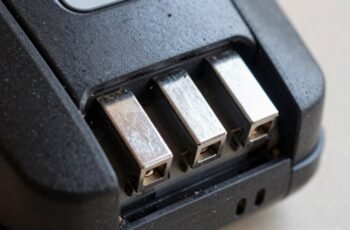
To guarantee your robot mower consistently returns to its charging station, proper setup of the station is essential. First, ensure the charging contacts are clean and free of debris, as poor contact impairs power transfer. The station should be positioned on a flat, stable surface, with at least 1 meter clearance on each side and 2 meters in front, to facilitate smooth navigation. Avoid placing the station near metal objects or thick foliage, which can interfere with signal transmission. Align the station’s charging contacts precisely with the mower’s charging points, and verify the station’s orientation is consistent with the mower’s return path. Regularly inspect the station for damage or obstruction, maintaining ideal conditions for reliable, consistent return operations.
Future Innovations in Robot Mower Return-to-Base Technology
Future advancements in robot mower return-to-base technology will likely incorporate sophisticated navigation systems that improve accuracy in complex terrains. Enhanced obstacle detection will enable more reliable operation in dynamic environments, reducing errors and interruptions. Additionally, smart charging integration is expected to streamline energy management, optimizing return paths and minimizing downtime.
Advanced Navigation Systems
Advancements in navigation systems are poised to considerably enhance the return-to-base capabilities of robot mowers. These innovations leverage cutting-edge technologies to improve accuracy, efficiency, and reliability. Precise localization techniques, such as simultaneous localization and mapping (SLAM), enable the mower to create detailed environment maps for optimized navigation. Integration of high-resolution GPS modules ensures accurate position tracking over large areas, reducing return errors. Additionally, adaptive path-planning algorithms optimize routes based on terrain and operational constraints. Enhanced sensor fusion combines inertial measurement units (IMUs), lidar, and cameras to maintain robust environment awareness. These systems collectively facilitate seamless, energy-efficient returns, even in complex or GPS-degraded environments, reinforcing the mower’s autonomous capabilities and minimizing downtime.
Enhanced Obstacle Detection
Building on the improvements in navigation systems, enhanced obstacle detection is set to revolutionize the safety and reliability of robot mower return-to-base functions. Advanced sensors, such as LiDAR, ultrasonic, and infrared, enable real-time obstacle identification and precise spatial mapping. These sensors work collectively to distinguish between static and dynamic objects, allowing the mower to adapt its path dynamically. Machine learning algorithms process sensor data to improve detection accuracy and predict obstacle movement, reducing false positives. This integration minimizes collision risks during return trips, especially in complex environments. Additionally, rapid obstacle recognition ensures timely rerouting or halting procedures, safeguarding both property and users. As obstacle detection technology advances, robot mowers will operate with increased autonomy, efficiency, and safety during return-to-base operations.
Smart Charging Integration
As smart charging integration evolves, robot mowers will increasingly coordinate with intelligent power management systems to optimize their return-to-base operations. This integration enables real-time monitoring of energy consumption, allowing mowers to assess battery levels against upcoming tasks and environmental conditions. Advanced algorithms will facilitate dynamic scheduling, ensuring timely returns that minimize downtime and energy expenditure. Such systems can also prioritize charging based on usage patterns and grid load, enhancing efficiency. Additionally, seamless communication protocols will allow mowers to coordinate with home energy networks, reducing peak demand and supporting renewable energy utilization.
- Real-time energy consumption analytics
- Dynamic scheduling based on environmental data
- Grid-aware charging prioritization
- Integration with home energy management systems
Frequently Asked Questions
How Long Does It Typically Take for a Robot Mower to Return to Base?
Typically, a robot mower takes about 1 to 3 minutes to return to its charging base, depending on the distance from the mower’s current location, obstacles, and the mower’s navigation efficiency.
Can Weather Conditions Affect the Mower’s Return Process?
Weather conditions can notably impact the mower’s return process; rain, snow, or extreme temperatures may cause delays or malfunctions, as the mower’s sensors and electronics are sensitive to moisture and temperature fluctuations, affecting navigation and docking accuracy.
What Should I Do if My Mower Frequently Fails to Return?
If your mower repeatedly fails to return, we check the charging station’s accessibility and signal strength, confirm the boundary wires are intact, and update firmware if needed. Proper maintenance prevents these issues, ensuring reliable, efficient operation.
Are There Privacy Concerns With Robot Mower Navigation Systems?
We recognize privacy concerns with navigation systems; they often collect spatial data. To address this, we guarantee data encryption, limit data sharing, and provide transparent privacy policies, helping protect user information while maintaining effective mower operation.
How Often Should I Clean Sensors to Ensure Proper Return Functionality?
We recommend cleaning sensors weekly, like tuning a finely crafted instrument, to maintain precise return functionality. Use a soft cloth or compressed air, ensuring dust and debris don’t obscure signals or cause misnavigation.
Conclusion
Just as a lighthouse guides ships safely to harbor through shifting tides and fog, our robot mowers rely on precise sensors and navigation systems to return reliably. By understanding and optimizing these technologies, we guarantee their journeys end safely and efficiently, extending their lifespan. As innovations continue to refine their guidance, we can trust these autonomous workers to navigate the complexities of our lawns—illuminating the path to smarter, more resilient outdoor maintenance.