While it may seem like a small component, the charging station for a robotic mower plays a critical role in maintaining uninterrupted lawn care, ensuring the device operates efficiently and reliably. Understanding its key features, installation requirements, and durability considerations can substantially impact overall performance. As technology advances, staying informed about the latest developments can help optimize your system’s longevity and effectiveness. Let’s explore what makes a quality charging station essential and how to select the right one for your needs.
Key Takeaways
- A charging station automatically recharges robotic mowers and ensures proper docking for continuous lawn maintenance.
- Choose stations compatible with your mower’s voltage, connector type, and suitable for your lawn size and terrain.
- Proper installation on a flat, sheltered surface enhances reliability and protects against weather elements.
- Regular maintenance includes cleaning contacts, inspecting connections, and updating firmware for optimal performance.
- Future trends include wireless charging, smart home integration, and enhanced safety and weather resistance features.
What Is a Charging Station for Robotic Mowers and Why Does It Matter?
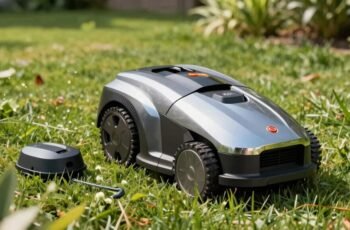
A charging station for robotic mowers is a dedicated docking unit that automatically recharges the mower’s batteries when not in operation. These stations are designed with electrical contacts that connect seamlessly with the mower’s charging points, guaranteeing efficient energy transfer. They often incorporate safety features such as short-circuit protection and weatherproof enclosures, enabling outdoor placement. The station’s precision alignment mechanisms ensure proper docking, minimizing user intervention. The importance of a charging station lies in maintaining peak battery health, extending the mower’s operational lifespan, and ensuring continuous lawn coverage. Proper placement and reliable connection are critical for uninterrupted mowing cycles. In essence, the charging station functions as the core component that sustains the robotic mower’s autonomous operation, making it indispensable for effective and maintenance-free lawn care.
Key Features to Look for in a Robotic Mower Charging Station
When selecting a robotic mower charging station, prioritizing key features guarantees reliable and efficient operation. Essential attributes include robust power connectivity, guaranteeing consistent energy transfer without interruption. Compatibility with the mower’s charging specifications—voltage, current, and connector type—is critical for peak performance. Durability is indispensable; the station should withstand environmental factors like moisture, debris, and temperature fluctuations. An advanced docking mechanism facilitates precise alignment, reducing wear and ensuring secure contact. Integrated safety features, such as overload protection and automatic shutoff, prevent damage to both the station and mower. Additionally, a compact, space-efficient design minimizes installation complexity. Overall, focusing on these technical features guarantees the station operates reliably, prolongs lifespan, and maintains the mower’s efficiency across multiple charging cycles.
How to Choose the Right Charging Station for Your Lawn Size and Terrain
Selecting the appropriate charging station depends on accurately evaluating your lawn size and terrain complexity. Larger lawns require stations with extended communication and power capabilities, while uneven or rugged terrain demands adaptive docking solutions. Understanding these specifications guarantees ideal compatibility and efficiency for your robotic mower.
Lawn Size Compatibility
How do you determine the appropriate charging station for your lawn’s size and terrain? First, assess your lawn’s dimensions; larger lawns require higher capacity stations with extended battery management. Next, consider the mower’s maximum coverage per charge, which influences station placement and capacity. The table below illustrates key parameters:
| Lawn Size Range | Recommended Station Capacity | Terrain Consideration |
|---|---|---|
| Up to 0.5 acres | Standard capacity | Flat terrain |
| 0.5–1 acres | High-capacity | Slight slopes |
| 1–2 acres | Extra-high capacity | Varied terrain |
| Over 2 acres | Commercial-grade | Complex terrain |
Selecting a station aligned with these parameters ensures suitable operation and minimizes downtime.
Terrain Adaptability
Evaluating your lawn’s terrain is essential to choosing the appropriate charging station, as it directly impacts the mower’s performance and longevity. For uneven or hilly terrain, select a station with a robust mounting system and stable placement to prevent shifting or tipping. Flat, well-maintained lawns allow for standard stations with minimal elevation considerations. Consider the following factors:
- Surface stability: Verify the station is placed on firm, level ground to maintain consistent contact.
- Weather resistance: For exposed sites, choose weatherproof stations to prevent damage from moisture or debris.
- Accessibility: Position the station where the mower can easily navigate without obstacles, especially on complex terrain.
- Elevation requirements: For sloped lawns, opt for stations with adjustable or reinforced bases to accommodate gradients.
Installation Tips for Ensuring Your Charging Station Works Effectively
To optimize the performance of your robotic mower’s charging station, proper placement is critical; it should be level, sheltered from direct sunlight, and accessible for maintenance. Regular maintenance checks ensure connections remain secure and the station operates without interruption. Implementing these strategies guarantees consistent charging and extends the lifespan of your equipment.
Proper Placement Strategies
Choosing the ideal location for your robotic mower’s charging station is essential to guarantee dependable operation and minimal disruption. Proper placement ensures reliable docking, optimal power connection, and protection from environmental factors.
- Position the station on a flat, level surface to prevent misalignment.
- Place it in a shaded area to reduce heat buildup, which can affect battery performance.
- Ensure clear access to the docking area, free of obstacles and debris.
- Maintain at least 1-2 meters of clearance around the station for smooth navigation and maintenance.
These strategies optimize charging efficiency, prevent potential mechanical issues, and extend the lifespan of both the station and the mower. Precise placement is crucial for consistent, trouble-free operation.
Regular Maintenance Checks
How can we guarantee our robotic mower’s charging station remains reliable over time? Regular maintenance checks are essential for peak performance and longevity. We should inspect electrical connections for corrosion, looseness, or damage, ensuring all contacts are secure. Clean the charging contacts and station surface with a non-abrasive cloth and isopropyl alcohol to prevent dirt buildup that can impair charging efficiency. Verify that the station’s sensors and alignment guides are unobstructed and functioning correctly. Check for signs of wear or damage to the station’s casing and wiring, replacing components as needed. Regularly test the station’s power supply and backup systems to confirm consistent operation. Implementing these precise maintenance routines minimizes downtime and guarantees dependable charging, supporting the mower’s overall operational reliability.
Weather Resistance and Durability: Keeping Your Charging Station Safe Outdoors
Since outdoor environments expose charging stations to various weather conditions, guaranteeing their weather resistance and durability is essential for reliable operation. Proper design mitigates risks from elements such as moisture, UV exposure, and temperature fluctuations. Critical features include sealed enclosures to prevent water ingress, corrosion-resistant materials for structural components, and UV-stable coatings to withstand sunlight degradation. Additionally, environmental sensors can alert users to extreme conditions that might compromise equipment integrity. Consider the following elements:
- IP-rated enclosures providing water and dust resistance
- Use of stainless steel or treated plastics for corrosion resistance
- UV-resistant coatings to prevent material degradation
- Integrated thermal management to handle temperature variations
These features collectively ensure the charging station remains operational, safe, and resilient in diverse weather conditions.
Smart Integration: Connecting Your Charging Station With Home Automation Systems
Integrating the charging station with home automation systems guarantees seamless device connectivity, allowing for centralized control and monitoring. Automated system integration enables real-time status updates and scheduling, optimizing mower operation and maintenance. This connectivity enhances overall system efficiency and user convenience through precise automation.
Seamless Device Connectivity
Connecting your robotic mower’s charging station with home automation systems enhances overall efficiency and user convenience. Seamless device connectivity guarantees real-time communication between your mower, charging station, and other smart home components, enabling optimized operation. This integration allows for remote monitoring, status updates, and automatic scheduling adjustments based on environmental conditions or user preferences.
Key features include:
- Real-time data transmission for maintenance alerts
- Automated start/stop commands triggered by environmental sensors
- Integration with voice assistants for manual control
- Compatibility with scheduling apps for dynamic task management
Automated System Integration
Automated system integration enhances the functionality of your robotic mower’s charging station by enabling seamless communication with home automation platforms. This integration employs standardized protocols such as MQTT, Zigbee, or Z-Wave, facilitating real-time data exchange between the station and central control systems. It allows for remote status monitoring, automated scheduling adjustments, and maintenance alerts, optimizing operational efficiency. By embedding API compatibility, the charging station can trigger actions within broader smart home ecosystems, such as adjusting landscape lighting or activating security systems based on mower activity. Precise configuration guarantees secure, reliable connections, minimizing latency and data loss. Overall, automated system integration provides a cohesive, intelligent environment that maximizes mower uptime, simplifies management, and enhances user control through advanced, interconnected automation solutions.
Troubleshooting Common Charging Station Problems
When troubleshooting common charging station problems, it’s essential to systematically identify and address potential issues to guarantee reliable operation. Start by verifying the power source, ensuring the station receives consistent voltage and that connections are secure. Check for physical obstructions or debris around contact points, which can hinder electrical connection. Inspect the charging contacts for corrosion or damage, as these can impair charging efficiency. Finally, examine the station’s firmware and the mower’s communication interface for errors or misalignment.
- Confirm power supply stability and outlet functionality
- Clean or replace corroded contact points
- Remove debris blocking charging contacts
- Update firmware or reset the station and mower
Upgrading or Replacing Your Robotic Mower Charging Station
Upgrading or replacing your robotic mower’s charging station guarantees continued peak performance and compatibility with newer models. When considering an upgrade, evaluate the station’s power specifications, communication protocols, and physical connector compatibility to guarantee seamless integration. Modern stations may feature enhanced charging efficiency, improved weather resistance, and advanced data communication capabilities, which optimize operational reliability. Replacing an outdated unit involves verifying the station’s dimensions, power requirements, and connector types to match current mower models. Proper installation ensures correct alignment of charging contacts and secure mounting, reducing downtime. Upgrading or replacing proactively prevents charging failures, extends equipment lifespan, and maintains consistent mowing schedules. Focus on technical specifications and compatibility to maximize system performance and guarantee future-proof operation.
Cost Considerations and Budgeting for a Quality Charging Station
Budgeting for a high-quality robotic mower charging station requires careful analysis of both initial costs and long-term value. The investment involves not only the purchase price but also installation, maintenance, and potential upgrades. A premium station often features enhanced durability, faster charging times, and integrated safety mechanisms, which reduce operational disruptions.
Key considerations include:
- Material quality and weatherproofing standards to guarantee longevity
- Compatibility with specific mower models to prevent future costly replacements
- Additional features such as surge protection or remote monitoring
- Installation complexity and associated labor costs
Future Trends in Robotic Mower Charging Technology
Advancements in robotic mower charging technology are poised to markedly enhance operational efficiency and user convenience. Future developments will likely focus on rapid, high-efficiency charging methods, including advancements in solid-state batteries and wireless power transfer. These innovations aim to reduce downtime, enabling autonomous recharging with minimal interruption to mowing schedules. Intelligent charging systems may incorporate adaptive energy management, optimizing power input based on usage patterns and battery health, thereby extending service life. Integration with smart home ecosystems will allow seamless scheduling and remote monitoring of charging status. Furthermore, future stations may feature self-cleaning and maintenance capabilities, reducing manual intervention. These technological trends will collectively improve reliability, reduce operational costs, and enhance user experience by ensuring consistent, efficient power delivery tailored to the evolving needs of robotic mowing systems.
Frequently Asked Questions
How Long Does It Take for a Robotic Mower to Fully Charge?
It typically takes our robotic mowers about 60 to 120 minutes to fully charge, depending on the model and battery capacity. We recommend following specific manufacturer guidelines for ideal charging times and battery longevity.
Can Multiple Robotic Mowers Share a Single Charging Station?
Yes, multiple robotic mowers can share a single charging station if it’s designed with multiple charging docks or an automatic switching system, ensuring efficient charging without overlap or interference, provided the station’s specifications support multi-unit usage.
What Safety Features Are Included in Modern Charging Stations?
Modern charging stations incorporate advanced safety features like automatic shutoff, surge protection, and obstacle detection, ensuring safe operation and preventing damage or accidents. We prioritize these safeguards to protect your equipment and provide peace of mind during use.
Is Professional Installation Necessary for Outdoor Charging Stations?
Professional installation isn’t strictly necessary, but it’s highly recommended for outdoor charging stations to guarantee proper placement, secure connections, weatherproofing, and ideal performance, especially in complex terrains or challenging environmental conditions.
How Often Should I Clean or Maintain the Charging Station?
We suggest cleaning the charging station monthly by removing debris, checking for corrosion, and guaranteeing contacts are dry and unobstructed. Regular maintenance prevents connectivity issues, prolongs equipment lifespan, and assures peak charging performance for your robotic mower.
Conclusion
In short, selecting the right charging station combines technical precision with environmental resilience. While advanced features and seamless connectivity enhance efficiency, neglecting durability can lead to costly failures. Balancing cost with quality ensures reliable performance, but overlooking installation details risks operational issues. As technology evolves, integrating smart features offers convenience, yet fundamental robustness remains essential. Ultimately, a well-chosen charging station is an investment in both durability and automation—combining resilience with innovation for ideal lawn care.