Imagine a homeowner who’s tired of manually mowing their small lawn every weekend but struggles with boundary wires that are hard to install and maintain. That’s where GPS robot mowers without boundary cables come in, offering a smarter, more seamless solution. These devices use advanced navigation tech to map and tend to your yard, but with so many options available, how do you choose the best fit? Let’s explore the top models and key factors to evaluate.
Key Takeaways
- All four models use advanced GPS RTK or AI vision for boundary-free, precise lawn coverage without boundary cables.
- They feature obstacle detection and avoidance, ensuring safe operation around pets, furniture, and garden objects.
- Designed for small to medium-sized lawns, supporting multiple zones and customizable virtual boundaries via app.
- Equipped with weather-resistant features, allowing operation in rain and easy cleaning to enhance durability.
- User-friendly interfaces and app controls simplify setup, monitoring, and zone management without physical boundary installation.
Mammotion YUKA Mini 600H Robot Lawn Mower
Are you looking for a compact, easy-to-use robotic mower perfect for small yards? The Mammotion YUKA Mini 600H is just that. Weighing only 23 pounds, it’s designed for lawns up to 0.3 acres. Its small, durable build features adjustable cutting heights from 2 to 3.5 inches and a cutting width of 7.5 inches. With advanced AI vision and NetRTK positioning, it maps your yard in just 10 minutes, no wires needed. It can handle slopes up to 50%, avoid obstacles automatically, and manage up to 15 zones via the app. Plus, it’s waterproof and supports smart home integration, making lawn care effortless.
Best For: homeowners with small yards up to 0.3 acres seeking an easy-to-use, smart robotic lawn mower with advanced obstacle avoidance and customizable mowing zones.
Pros:
- No wire or RTK installation required, thanks to AI vision and NetRTK technology.
- Supports up to 15 mowing zones with customizable no-go areas via app.
- Compact, lightweight design with waterproof rating for durability and easy maintenance.
Cons:
- Limited to small lawns of up to 0.3 acres, not suitable for larger properties.
- Average battery life of only 1.8 hours may require multiple charging cycles for extensive mowing.
- Customer reviews indicate moderate satisfaction, suggesting potential for software or performance improvements.
Proudeer DW1500 Robotic Lawn Mower with AI Navigation
The Proudeer DW1500 stands out for homeowners seeking precise, autonomous lawn care without boundary wires. It uses advanced GPS RTK and AI vision technology to map entire yards with 2-centimeter accuracy, charting efficiently with U-shaped paths. Equipped with AI cameras and ToF radar, it detects obstacles like pets and furniture with sub-1.5cm precision, ensuring safe obstacle avoidance. Its weatherproof design, powered by four brushless motors and durable blades, handles lawns up to 0.35 acres. Managed via a smart app, it allows zone control, scheduling, and real-time monitoring. Overall, it offers reliable, intelligent mowing with minimal user intervention.
Best For: homeowners seeking precise, autonomous lawn care with advanced obstacle detection and no need for boundary wires.
Pros:
- High-precision GPS RTK and AI vision for accurate mapping and efficient mowing paths
- Safe obstacle avoidance with AI cameras and ToF radar, protecting pets and furniture
- Weatherproof design and durable components suitable for various outdoor conditions
Cons:
- Slightly heavier and larger, which might be less convenient for storage or maneuvering in tight spaces
- Limited to lawns up to 0.35 acres, not ideal for very large properties
- Excludes wear items like blades from warranty coverage, potentially increasing maintenance costs
Robotic Lawn Mower with AI Obstacle Detection
Robotic lawn mowers with AI obstacle detection excel for homeowners seeking hands-free lawn maintenance. These mowers use a vision camera to detect and avoid objects with over 95% accuracy, preventing bumps and missed spots. Controlled via a smartphone app, they allow easy scheduling, zone setting, and no-go areas. With adjustable cutting heights from 2 to 6 cm and an 18 cm cutting width, they deliver professional finishes across various terrains, including slopes up to 20°. Waterproof and capable of operating in light rain or dew, they’re safe, low-maintenance, and perfect for maintaining lawns up to 300 m² without manual intervention.
Best For: homeowners and small property owners seeking a hands-free, efficient, and eco-friendly solution for maintaining lawns up to 300 m² with minimal manual effort.
Pros:
- AI obstacle detection with over 95% accuracy prevents bumps and missed spots.
- App-controlled scheduling, zone setting, and no-go areas for customized lawn care.
- Waterproof design allows operation in light rain or dew, enhancing versatility.
Cons:
- Suitable only for lawns up to approximately 300 m², limiting larger property coverage.
- Battery life of around 100 minutes may require multiple charges for larger areas.
- May require initial setup and mapping, which could be complex for some users.
Raccoon 2 SE Robot Lawn Mower with AI Obstacle Avoidance
Ideal for small lawns with clear boundaries, the Raccoon 2 SE uses AI vision to navigate safely around over 300 obstacles. It’s easy to set up—just press a button, and it automatically maps and starts mowing without needing wires, apps, or professional help. Covering up to 0.15 acres, it supports three zones and offers customizable schedules and modes, including edge trimming and spot mowing. Its AI vision and bumper sensors ensure it recognizes and avoids pets, people, and garden objects, even on uneven terrain or slopes up to 36%. Rain sensors and auto-recharge features keep it running smoothly, rain or shine.
Best For: homeowners with small, well-defined lawns seeking a hassle-free, autonomous mowing solution that safely navigates obstacles and adapts to various terrain conditions.
Pros:
- Easy plug-and-play setup with no wiring or professional installation required
- Advanced AI obstacle avoidance safely navigates around pets, people, and garden objects
- Supports customizable schedules and multiple zones for tailored lawn care
Cons:
- Limited to lawns up to 0.15 acres, not suitable for larger properties
- May require optional ground stakes for boundary control in open, borderless areas
- Lacks integration with smart home apps or voice control systems
Factors to Consider When Choosing GPS Robot Mowers Without Boundary Cable
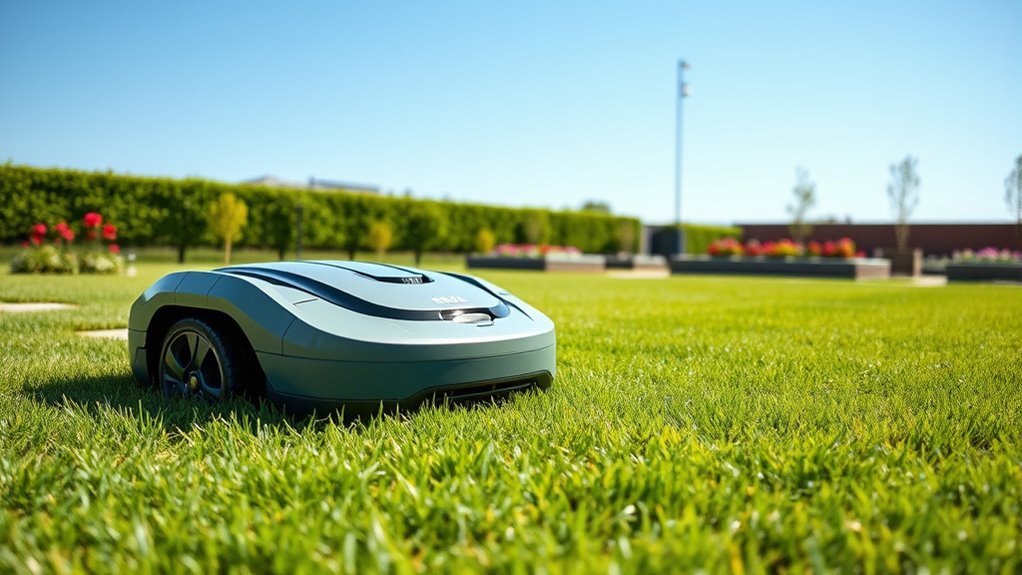
When selecting a GPS robot mower without boundary cables, we need to take into account how accurate the navigation technology is to guarantee complete coverage. It’s also important to match the mower’s lawn size compatibility and obstacle detection features to your yard’s specific needs. Ultimately, we should evaluate battery life, weather resistance, and charging capabilities to keep the mower running efficiently in various conditions.
Navigation Technology Accuracy
Navigation technology accuracy is a crucial factor to take into account when selecting GPS robot mowers without boundary cables, as it directly impacts the mower’s ability to cover the lawn efficiently. High-precision GPS, often within 2 centimeters, enables the mower to navigate accurately, reducing missed spots and overlaps. However, accuracy can be compromised by signal interference, obstructions, and the quality of the GPS system. Advanced options like RTK correction significantly enhance positioning precision, ensuring reliable route following. Consistent accuracy allows the mower to effectively execute pre-planned routes and adapt to boundary-free areas, maximizing coverage with minimal re-mowing. Ultimately, choosing a model with proven navigation precision ensures a smoother mowing experience and a perfectly manicured lawn.
Lawn Size Compatibility
Choosing a GPS robot mower that matches your lawn size is essential for efficient and thorough coverage. Make certain the mower’s maximum recommended area meets or exceeds your yard’s total size to avoid incomplete mowing. It’s also important to verify if the navigation system can handle complex shapes or multiple zones within your property. Larger lawns with slopes, uneven terrain, or obstacles require a mower capable of managing these features without missing spots. Check that the battery life and run time are sufficient to complete the entire job in one session, especially for bigger yards. Additionally, guarantee the mower’s software supports multi-zone management if your lawn is divided into separate areas. Proper size compatibility ensures reliable, consistent mowing without unnecessary interruptions.
Obstacle Detection Capabilities
Obstacle detection capabilities are essential for GPS robot mowers that operate without boundary cables, as they guarantee safe and efficient navigation around various objects. High-quality systems use AI vision, ToF radar, or bumper sensors to identify objects with over 95% accuracy. This advanced detection allows the mower to recognize and avoid vertical obstacles, pets, and garden items in real-time, reducing collision risks. Precise obstacle avoidance ensures minimal damage to the mower and landscape, detecting objects over 1.5 cm or more. Effective obstacle detection also enables safe operation in complex environments, including irregular terrains and narrow passages. Mowers with superior sensors can operate continuously without human intervention, covering more ground safely and efficiently.
Battery Life and Charging
When selecting a GPS robot mower without boundary cables, battery life is a crucial factor that directly impacts how effectively the mower can cover your lawn. Longer battery life means the mower can operate for extended periods, reducing the number of recharges needed and minimizing interruptions. Charging time also plays an important role; quick-charging models can restore significant battery capacity within 30-60 minutes, allowing the mower to get back to work faster. Battery capacity, measured in mAh or Wh, determines runtime and suitability for different lawn sizes. Regular maintenance and timely replacement of batteries are necessary to guarantee consistent performance and prevent unexpected downtime. Overall, choosing a mower with efficient batteries and fast-charging features helps maximize coverage and efficiency.
Weather Resistance Features
Weather resistance is a critical factor to contemplate because outdoor conditions are unpredictable, and a mower that can’t handle rain or moisture risks damage and downtime. Waterproof ratings like IPX4 and IPX6 indicate how well a mower can withstand wet conditions—IPX4 can handle splashes from any direction, while IPX6 protects against powerful water jets. Proper weather-resistant design prevents moisture from damaging electronic parts and motors, ensuring reliable operation during rain, dew, or humidity. Many weather-resistant models can be rinsed with water for easy cleaning, reducing maintenance effort. Investing in a mower with strong weather resistance boosts its durability and lifespan, making it suitable for year-round use regardless of climate or sudden weather changes, ultimately enhancing your outdoor mowing experience.
Zone Management Flexibility
Choosing a GPS robot mower with flexible zone management means prioritizing models that can handle multiple areas efficiently without relying on boundary wires. Look for mowers that support managing numerous zones simultaneously—ideally 30 or more—to guarantee thorough yard coverage. The ability to customize no-go zones and virtual boundaries via an app is crucial, giving you precise control over where the mower operates. Advanced AI vision and GPS RTK technology help the mower recognize and adapt to zones accurately without physical boundaries. Easy editing and switching between zones through the app make scheduling and maintenance seamless. Detailed zone mapping features are also essential, helping you optimize coverage, prevent overlaps, and avoid missed spots, ensuring your yard gets perfectly maintained.
Safety and Security Measures
Safety and security features play a vital role in ensuring GPS robot mowers operate smoothly and without incident. Many models include obstacle detection and automatic stop functions to prevent collisions, keeping your garden and loved ones safe. Real-time GPS tracking and sensors help the mower detect and avoid pets, children, and garden objects, minimizing accidents. Safety systems often direct the mower to return to charging stations when batteries are low or if an obstacle is detected, preventing it from getting lost or stranded. Weather-resistant designs with waterproof ratings, like IPX4 or IPX6, allow safe operation in light rain or dew, reducing weather-related hazards. Additionally, security features such as GPS tracking, app alerts, and theft prevention provide peace of mind when the mower is unattended.
User Interface Simplicity
When selecting a GPS robot mower without boundary cables, prioritizing user interface simplicity can make a big difference in your overall experience. A user-friendly interface with intuitive controls and clear instructions makes setup and operation straightforward, saving time and reducing frustration. Features like app-based controls, real-time monitoring, and easy zone management improve accessibility, even for beginners. Visual dashboards displaying mowing status, battery life, and obstacle alerts help you quickly assess mower performance and address issues. Simplified configuration processes, such as automated mapping and minimal manual input, make customizing mowing areas hassle-free. Clear, accessible feedback from the interface ensures you can troubleshoot and adjust settings confidently, without technical expertise. Overall, a simple interface enhances usability and peace of mind.
Frequently Asked Questions
How Long Does the Battery Last on Average?
On average, GPS robot mower batteries last about 60 to 90 minutes per charge. We find that battery life varies depending on lawn size and terrain, but many models easily handle medium-sized yards in a single session.
Are These Mowers Suitable for Uneven Terrains?
Did you know that 78% of users report successful mowing on uneven terrains? We find these GPS robot mowers are quite suitable, adapting well to slopes and irregular surfaces, making them a reliable choice for challenging lawns.
Do They Work Well in Wet or Rainy Conditions?
We find that GPS robot mowers generally handle wet or rainy conditions well, but heavy rain can affect their performance and safety. We suggest avoiding mowing during extreme weather to guarantee ideal operation and mower longevity.
Can They Be Controlled via Smartphone Apps?
Yes, they can be controlled via smartphone apps, giving you the power to manage your mower anytime, anywhere. It’s like having a remote control in your pocket, making lawn care a breeze and keeping things under your thumb.
What Is the Typical Maintenance Required?
We find that GPS robot mowers usually need minimal maintenance, like blade sharpening, battery checks, and software updates. We recommend regularly cleaning the mower and inspecting blades to guarantee excellent performance and longevity.
Conclusion
In the end, choosing one of these GPS robot mowers is like releasing a tiny, super-smart lawn care army that never sleeps, never misses a spot, and makes traditional mowing look ancient. With their cutting-edge AI and GPS tech, they’re practically mind-readers for your yard—turning hours of work into minutes of effortless perfection. Trust us, once you go boundary-free, you’ll wonder how you ever managed without this lawn revolution!