If you’re considering a boundary-free robot lawn mower, you’re probably looking for options that simplify installation and handle diverse terrains. We’ve identified three top models that stand out for their advanced features and ease of use. Each offers unique advantages depending on your lawn’s size and complexity. Curious about which one best fits your outdoor space? Let’s explore these options and what makes them suitable for different mowing needs.
Key Takeaways
- Boundary-free robot mowers like Mammotion LUBA mini 2, LawnMaster OcuMow, and Raccoon 2 SE use AI vision, LiDAR, or optical sensors for navigation without wires.
- These models can operate seamlessly across complex terrains and obstacle-rich environments, eliminating the need for boundary wire setup.
- They feature advanced obstacle detection and avoidance systems, ensuring safe, autonomous mowing in cluttered yards.
- Boundary-free mowers are ideal for quick deployment, requiring minimal installation and setup compared to wire-based systems.
- They offer customizable navigation and zone management through AI, app control, or virtual fencing, enhancing user convenience.
Mammotion LUBA mini 2 AWD Robot Lawn Mower
The Mammotion LUBA mini 2 AWD Robot Lawn Mower is ideal for homeowners with medium-sized lawns up to 0.37 acres who want a smart, reliable, and safe mowing solution. It features advanced 360° LiDAR and dual-camera AI vision, providing all-around awareness and obstacle detection for safe autonomous operation. The mower adjusts blade height via app, supports DropMow for mapping-free mowing, and handles slopes up to 80%. Its adaptive suspension and omni wheels enable it to navigate uneven terrain, curbs, and thresholds. With efficient battery management and the ability to cover multiple zones quickly, it offers a seamless, maintenance-free lawn care experience.
Best For: homeowners with medium-sized lawns up to 0.37 acres seeking a smart, safe, and efficient robotic mower that handles slopes and uneven terrain with advanced obstacle detection.
Pros:
- Equipped with 360° LiDAR and dual-camera AI vision for comprehensive obstacle detection and safe autonomous operation
- Handles slopes up to 80% and navigates uneven terrain with adaptive suspension and omni wheels
- Supports app control for adjustable blade height, scheduling, and energy-efficient charging options
Cons:
- May be less suitable for very large lawns beyond 0.37 acres
- Requires initial setup and app configuration, which might be complex for some users
- Limited to lawns with specific terrain features; not optimal for very intricate or highly landscaped gardens
LawnMaster OcuMow Robot Lawn Mower for Small Lawns
Ideal for small lawns up to 2,000 square feet, the LawnMaster OcuMow uses advanced obstacle detection to navigate efficiently. It employs optical navigation with sensors and a high dynamic range camera to identify grass under different lighting conditions, ensuring thorough coverage. Ultrasonic sensors detect obstacles as small as 6 inches, automatically rerouting to avoid collisions. It mows grass clippings onto the lawn to nourish the grass and offers up to 3 hours of runtime per charge with a quick charger. Setup is simple, using magnetic strips for virtual fences, and it handles slopes up to 35%. Proper lawn edging optimizes mowing performance.
Best For: homeowners with small lawns up to 2,000 square feet seeking an easy-to-set-up, obstacle-aware robotic mower for efficient grass maintenance.
Pros:
- Advanced obstacle detection with sensors and high dynamic range camera for thorough coverage
- Easy installation using magnetic boundary strips without the need for app setup
- Capable of handling slopes up to 35%, suitable for varied terrains
Cons:
- Designed primarily for small lawns; not ideal for larger or complex landscapes
- May require manual edging and trimming for perfect lawn borders
- Limited runtime of up to 3 hours per charge, necessitating additional batteries for larger tasks
Raccoon 2 SE Robotic Lawn Mower with Obstacle Avoidance
If you need a robotic mower that navigates complex gardens safely, the Raccoon 2 SE with obstacle avoidance is an excellent choice. It’s easy to set up with a plug-and-play design, requiring no wire burying or professional installation. Suitable for lawns up to 0.15 acres, it supports multiple zones and customizable schedules via the app. With AI vision and bumper sensors, it can recognize over 300 obstacle types, including pets and garden objects, and handles uneven terrain, slopes, and narrow passages. Its safety features automatically pause or return to the charging station when needed, ensuring reliable, safe operation in various weather conditions.
Best For: homeowners with small to medium-sized gardens seeking an easy-to-use, obstacle-aware robotic mower that requires minimal setup and maintenance.
Pros:
- Simple plug-and-play setup with no need for wire burying or professional installation
- Advanced obstacle avoidance with AI vision and bumper sensors, recognizing over 300 obstacle types
- Handles challenging terrains, slopes up to 36%, and narrow passages with ease
Cons:
- Limited to lawns up to 0.15 acres, may not suit larger properties
- Supports up to three zones, which might be restrictive for very complex landscapes
- No mention of GPS-based navigation, potentially limiting precision in larger or more intricate gardens
Factors to Consider When Choosing Robot Lawn Mowers Without Boundary Wire
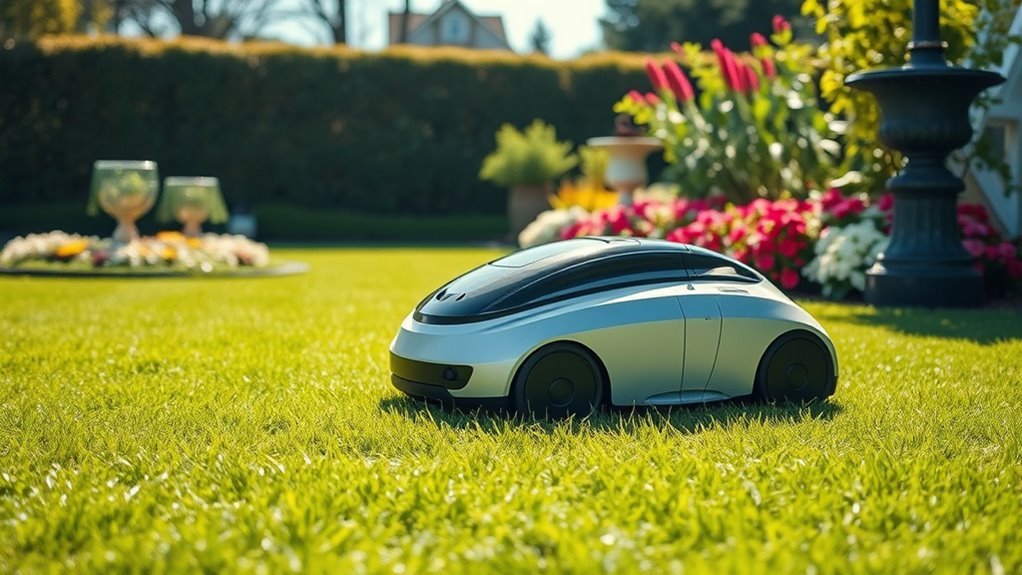
When selecting a robot lawn mower without boundary wire, we need to evaluate the navigation technology it uses and how well it detects obstacles. It’s also important to match the mower’s lawn size and terrain handling abilities with your yard’s specific features. Ultimately, understanding the boundary setup methods helps guarantee the mower functions smoothly in your space.
Navigation Technology Types
Choosing a robot lawn mower without boundary wires largely depends on the type of navigation technology it employs. Optical sensors use cameras and terrain detection to guide the mower, making them effective in straightforward lawns. AI vision takes this further by recognizing objects, edges, and zones, enabling dynamic navigation and better zone management. LiDAR provides 360° distance measurement, creating detailed maps of complex or cluttered yards, and preventing collisions. GPS-based systems rely on satellite signals, making them ideal for large areas and intricate boundary recognition without physical wires. Each technology offers unique advantages: optical is simple, AI vision is adaptive, LiDAR excels in precision, and GPS suits expansive properties. Understanding these options helps us select the best mower tailored to our yard’s layout and needs.
Obstacle Detection Features
Obstacle detection features are vital for ensuring our robot lawn mower navigates safely around obstacles without boundary wires. These systems use sensors, cameras, or AI vision to identify objects in its path, preventing collisions. Advanced models can recognize over 300 obstacle types, including pets, garden tools, and furniture. The effectiveness is boosted by multiple sensors, such as ultrasonic, infrared, and bump sensors, working together for thorough coverage. Some mowers can detect obstacles as small as 6 inches or over 1.5 inches in height, ensuring even tiny hazards are avoided. Proper obstacle detection allows the mower to operate smoothly in cluttered or complex environments, reducing the risk of damage or accidents. This technology is essential for safe, boundary-wire-free lawn maintenance.
Lawn Size Compatibility
Selecting a robot lawn mower that matches your yard’s size is essential for efficient and thorough mowing. You’ll want to check the mower’s maximum coverage area to verify it can handle your lawn without overloading or leaving patches unmowed. For smaller yards, models that cover up to 2,000 square feet or 0.15 acres often suffice, while larger lawns may need mowers with higher capacity. It’s also important to evaluate your lawn’s shape and any irregular boundaries, making sure the mower can navigate these within its limits. If your yard is divided or has complex features, look for models supporting multiple zones. Keep in mind that larger lawns may require longer mowing times or multiple charges, impacting your choice.
Terrain Handling Abilities
Without the need for boundary wires, robot lawn mowers rely heavily on advanced sensors and AI vision to navigate diverse terrains. These features help them detect obstacles, uneven ground, and landscape features with precision. They can handle slopes up to approximately 35-36%, making them suitable for hilly or uneven yards. Many models have adaptive suspension systems or deep tread wheels to manage rough surfaces, roots, or curb edges efficiently. Obstacle detection sensors, including ultrasonic and AI vision, enable safe operation around complex obstacles. Additionally, their ability to climb over thresholds up to around 45mm and navigate narrow passages guarantees they can cover a variety of landscape features without getting stuck. This versatility makes them ideal for challenging terrains.
Boundary Setup Methods
When choosing a robot lawn mower that doesn’t rely on boundary wires, it’s essential to understand the various boundary setup methods available. Many models use advanced AI vision, LiDAR, or optical sensors to detect lawn edges and obstacles, eliminating the need for physical wires. Some employ magnetic strips or non-electric boundary markers to define restricted zones without wiring. Virtual fencing technologies, such as magnetic or infrared sensors, create virtual boundaries that the mower recognizes automatically. Obstacle avoidance sensors, like ultrasonic or bumper sensors, work alongside boundary detection to prevent crossing into off-limits areas. The setup process often involves positioning these sensors or markers, with some devices offering automatic boundary recognition through AI or visual navigation systems, making the process straightforward and flexible.
Battery Life Duration
Battery life duration is a crucial factor to take into account because it directly impacts how much area a robotic lawn mower can cover in a single session. Longer battery life means less downtime and more efficient mowing, especially for larger yards. Battery duration is usually measured in hours of continuous operation or the total area covered per charge. Higher-capacity batteries enable the mower to handle more complex terrains and longer sessions without frequent recharging. However, factors like grass density, terrain steepness, and mower load can affect battery performance. Some models feature smart charging technologies that optimize battery lifespan by limiting unnecessary cycles or scheduling recharges during off-peak hours. Choosing a mower with adequate battery life ensures consistent coverage and minimizes interruptions during mowing.
Safety and Weather Resistance
Safety and weather resistance are key considerations when selecting robot lawn mowers that operate without boundary wires. Modern models incorporate advanced obstacle detection systems like AI vision and bumper sensors, helping them avoid people, pets, and garden objects safely. Weather resistance features such as rain sensors and automatic return-to-charging stations protect the mower from damage and guarantee consistent lawn care regardless of weather. Water-resistant casings and sealed components enable these mowers to operate safely in rain or high humidity. Safety features like obstacle avoidance and weather-triggered shutdowns minimize risks during adverse conditions. Overall, proper weather resistance combined with reliable obstacle detection assures safe, dependable, and efficient autonomous mowing, making these mowers suitable for diverse outdoor environments.
Frequently Asked Questions
How Long Does the Battery Last on Average?
On average, the battery lasts around 60 to 90 minutes, depending on the mower’s size and grass thickness. We find that higher capacity batteries extend mowing time, making the process more efficient and less frequent.
Can These Mowers Handle Uneven Terrain Effectively?
Absolutely, these mowers dance over uneven terrain like skilled performers, adapting to bumps and dips with grace. We’ve seen them conquer challenging landscapes, making yard care effortless and transforming your outdoor space into a lush, manicured masterpiece.
What Maintenance Is Required for Boundary Wire-Free Mowers?
Boundary wire-free mowers need minimal maintenance; we regularly clean their blades, check for debris, update software if needed, and guarantee sensors are unobstructed. This keeps them running smoothly and efficiently, saving us time and effort.
Are They Safe for Pets and Children?
Yes, they’re generally safe for pets and children because they use advanced sensors to detect obstacles and stop, preventing accidents. We always recommend supervising initially and ensuring the mower’s safety features are enabled for peace of mind.
How Do These Mowers Navigate in Complex Garden Layouts?
We navigate complex gardens using advanced sensors, cameras, and mapping technology, allowing us to detect obstacles, adapt to different terrains, and efficiently mow even intricate layouts without requiring boundary wires for guidance.
Conclusion
Choosing the right boundary-free robot lawn mower depends on our yard’s size, terrain, and obstacle challenges. Whether we need the power of Mammotion LUBA mini 2 AWD, the simplicity of LawnMaster OcuMow, or the obstacle-savvy Raccoon 2 SE, there’s a perfect fit for every outdoor space. Isn’t it time we let technology do the hard work while we enjoy a lush, well-manicured lawn without the hassle of wires?