Like a chess master planning their next move, selecting the right robot lawn mower demands careful consideration of multiple technical factors. From yard size to terrain and budget constraints, each decision impacts performance and longevity. We recognize the importance of precision in setup and operation, which is why understanding key features and common pitfalls can help you avoid costly mistakes. As we guide you through the essentials, you’ll discover how to optimize your mower’s efficiency and safety for long-term maintenance.
Key Takeaways
- Assess your lawn size and terrain to choose a mower with appropriate battery life and navigation features.
- Prioritize models with reliable boundary wiring and obstacle sensors for complete, safe coverage.
- Consider your budget versus desired features, balancing basic functionality with advanced navigation and mapping.
- Regularly maintain blades, deck, and check boundary wire to ensure optimal performance and longevity.
- Properly install boundary wires and place the charging station on a flat, unobstructed surface to avoid operational issues.
What Are Robot Lawn Mowers and How Do They Work?
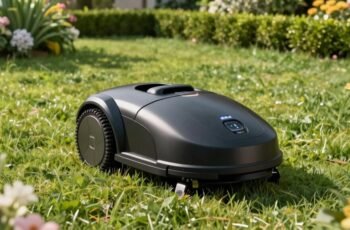
Robot lawn mowers are autonomous devices designed to efficiently maintain lawns by performing regular mowing tasks without human intervention. They operate using embedded sensors, boundary wires, and navigation algorithms to guarantee precise coverage. The boundary wire creates a virtual perimeter, preventing the mower from straying into undesired areas. In addition, collision sensors detect obstacles, prompting the mower to change direction and avoid collisions. Mowers are equipped with electric motors that power rotary blades, which cut grass in a systematic pattern. Many models utilize GPS and gyroscopes for advanced navigation, optimizing mowing paths and coverage efficiency. The devices are programmed via onboard controls or companion apps, allowing scheduling and customization. Overall, their combination of sensor technology and intelligent navigation enables consistent, autonomous lawn maintenance.
Key Features to Consider Before Buying a Robot Mower
When selecting a robot mower, we prioritize battery life and charging efficiency to guarantee extended operation without frequent downtime. Adjustable cutting height is also essential for maintaining different grass lengths and turf conditions. By focusing on these features, we can optimize performance and tailor the mower to specific yard requirements.
Battery Life and Charging
Since battery life directly impacts the mower’s ability to complete mowing cycles without frequent recharging, it’s crucial to evaluate the capacity and efficiency of the power source. Lithium-ion batteries are standard, offering high energy density and fast recharge times. Look for models with at least 1.5 Ah to 2 Ah battery capacity for maximum runtime, especially on larger lawns. Consider the mower’s energy consumption rate—more efficient models extend operational time per charge. Charging times vary; some units recharge in under an hour, while others take several hours. Automated docking stations facilitate quick recharges, reducing downtime. Additionally, battery longevity depends on proper maintenance and usage within recommended parameters. Understanding these technical specifications ensures the mower can handle your yard’s size and terrain without frequent interruptions.
Cutting Height Adjustments
Have you considered how precise control over cutting height can optimize your lawn’s health and appearance? Adjustable cutting height is crucial for tailored mowing, affecting grass density, root development, and overall vitality. Look for models with a broad range of height settings—usually between 1 and 3 inches—to accommodate different grass types and seasonal needs. A reliable mower should allow incremental adjustments, often in 0.2-inch steps, for fine-tuning. Mechanical or electronic adjustments should be smooth and secure, preventing unintended changes during operation. Additionally, check if the mower’s deck height can be quickly and easily modified without tools, ensuring flexibility for different terrains and growth stages. Proper cutting height management promotes a healthy, lush lawn while reducing stress on the mower’s motor and blades.
How to Determine the Right Size and Battery Life for Your Yard
To select the appropriate size and battery life for your robot lawn mower, it’s essential to accurately assess your yard’s dimensions and terrain complexity. Smaller yards (up to 0.2 acres) typically require less battery capacity, while larger areas demand extended runtime and larger cutting decks. For uneven terrain or multiple zones, a mower with higher battery capacity guarantees uninterrupted operation. Consider the following factors:
| Yard Size | Terrain Complexity | Recommended Battery Capacity |
|---|---|---|
| Up to 0.2 acres | Flat | 20-30 minutes runtime |
| 0.2-0.5 acres | Slight slope | 30-60 minutes runtime |
| 0.5-1 acre | Hilly/multiple zones | 60+ minutes runtime |
Matching these parameters ensures ideal performance and efficient lawn coverage.
Comparing Budget-Friendly vs. Premium Robot Mowers
When comparing budget-friendly and premium robot mowers, the primary differences often lie in initial cost and feature set, with premium models offering advanced navigation and cutting-edge sensors. Performance and durability typically improve with higher-end units, supporting longer service life and more consistent mowing results. Understanding these distinctions helps us evaluate how each option aligns with specific yard requirements and long-term maintenance considerations.
Cost Differences and Features
While budget-friendly robot mowers often provide basic cutting functionality at a lower cost, premium models incorporate advanced features that justify their higher price points. Budget models typically include limited programmable zones, basic sensors, and shorter battery life, focusing solely on core mowing. In contrast, premium models offer GPS navigation, multi-zone mapping, obstacle detection with infrared sensors, and longer-lasting lithium-ion batteries, enhancing efficiency and coverage. The following table outlines key cost-related feature differences:
| Feature | Budget-Friendly Mowers | Premium Mowers |
|---|---|---|
| Navigation | Random or manual | GPS-guided with mapping |
| Sensors | Basic bump sensors | Infrared obstacle detection |
| Battery Life | Shorter runtime | Extended runtime, fast charging |
| Zones & Scheduling | Limited zones | Multiple zones, advanced scheduling |
Performance and Durability
Although budget-friendly robot mowers are designed to perform basic grass-cutting tasks effectively, their durability and long-term performance often fall short compared to premium models. Lower-cost units typically feature less robust components, leading to quicker wear and increased maintenance needs. Specifically:
- Motor Lifespan: Cheaper models often use smaller, less powerful motors prone to overheating and early failure.
- Battery Quality: Budget mowers usually contain lower-capacity batteries with reduced cycle life and quicker capacity loss.
- Cutting Components: Blades and cutting decks are made from thinner, less durable materials, resulting in faster degradation.
- Weather Resistance: Less sophisticated weatherproofing makes budget models more vulnerable to environmental damage.
In contrast, premium mowers incorporate high-grade materials, reinforced motors, and advanced weatherproofing, ensuring sustained performance and durability over time.
Installation Tips: Setting Up Your Robot Lawn Mower Safely
Proper installation is critical to guarantee your robot lawn mower operates safely and efficiently. Begin by establishing a clear boundary wire perimeter around your lawn, ensuring it’s taut and securely anchored to prevent displacement. Use appropriate connectors to join wire segments and verify continuity with a multimeter to avoid signal interruptions. Position the charging station on a flat, level surface with unobstructed access, maintaining at least 1.5 meters of clearance on all sides. Avoid obstacles like thick grass, roots, or debris near the station that could hinder docking. Configure the boundary and mowing area via the mower’s control interface, confirming no gaps or overlaps. Finally, double-check all connections, power sources, and safety sensors to ensure proper functionality before initiating the mowing cycle.
Common Mistakes to Avoid When Choosing a Robot Mower
Choosing the right robot mower requires careful consideration to prevent costly mistakes that can compromise performance and safety. Common pitfalls include:
- Ignoring lawn size and terrain: Selecting a mower with insufficient battery capacity or inadequate cutting width results in incomplete coverage and frequent recharging.
- Overlooking obstacle navigation: Failing to evaluate sensors and navigation systems can lead to collisions or missed spots, especially on complex landscapes.
- Neglecting boundary setup: Poorly installed boundary wires or wireless fencing can cause the mower to leave the designated area, risking damage or safety hazards.
- Disregarding power and blade specifications: Choosing a mower with inadequate motor power or dull blades reduces cutting efficiency, increasing wear and maintenance needs.
Avoid these mistakes by appraising your lawn’s specific requirements with precision and selecting a model aligned with those parameters.
Troubleshooting and Maintaining Your Robot Lawn Mower for Long-Term Performance
Regular maintenance and prompt troubleshooting are essential for ensuring your robot lawn mower continues to operate efficiently over time. Regularly inspect blades for dullness or damage, and clean the cutting deck to prevent clogging. Check the charging contacts and battery health periodically to avoid power issues. When troubleshooting, verify boundary wire continuity and signal strength, and recalibrate sensors if necessary. To optimize long-term performance, keep detailed logs of issues and repairs.
| Issue | Diagnostic Step | Solution |
|---|---|---|
| Blades dull or damaged | Visual inspection, test cut quality | Sharpen or replace blades |
| Charging problems | Check contacts, battery status | Clean contacts, replace battery if needed |
| Navigation errors | Sensor calibration, boundary check | Recalibrate sensors, repair wire |
Frequently Asked Questions
How Loud Are Robot Lawn Mowers During Operation?
Robot lawn mowers typically operate between 55 to 65 decibels, comparable to a quiet conversation, making them unobtrusive. Their sound levels are designed to minimize disturbance, allowing them to work quietly even during early mornings or late evenings.
Can Robot Mowers Handle Uneven or Hilly Terrain?
We find robot mowers can navigate uneven terrain like skilled dancers on a varied stage, thanks to adjustable blades, powerful motors, and specialized sensors, ensuring efficient cutting while maintaining stability on hills, slopes, and irregular ground surfaces.
Are Robot Mowers Suitable for Pet Owners?
Robot mowers are suitable for pet owners, especially models with boundary wire systems and obstacle sensors. They efficiently navigate around pets, minimizing disturbance, but we recommend choosing quiet models and monitoring initial uses to guarantee safety.
What Safety Features Should I Look For?
We believe safety features are vital; look for obstacle detection with infrared or ultrasonic sensors, automatic shutoff when lifted, and boundary wire systems. These guarantee precise operation, prevent accidents, and protect both users and pets effectively.
How Do I Schedule Mowing Times With a Robot Mower?
We set our robot mower’s schedule through its control panel or mobile app, selecting specific days and times. Confirm the mower’s time settings are accurate, and verify the schedule activates correctly to maintain a consistent, efficient mowing routine.
Conclusion
Ultimately, selecting the right robot lawn mower hinges on understanding your yard’s specific needs and the technology’s capabilities, aligning them precisely. When installation is meticulous and maintenance routines follow manufacturer guidelines, the mower’s performance seamlessly integrates into your landscape management. It’s a nuanced balance—much like a well-calibrated sensor—that guarantees ideal operation, longevity, and safety. By approaching your choice with this detailed perspective, you’re more likely to enjoy a reliable, efficient, and enduring mowing solution.